
2025 Latest SSE-Engineer Exam Dumps Recently Updated 54 Questions
Palo Alto Networks SSE-Engineer Real 2025 Braindumps Mock Exam Dumps
Palo Alto Networks SSE-Engineer Exam Syllabus Topics:
| Topic | Details |
|---|---|
| Topic 1 |
|
| Topic 2 |
|
| Topic 3 |
|
| Topic 4 |
|
NEW QUESTION # 14
An intern is tasked with changing the Anti-Spyware Profile used for security rules defined in the GlobalProtect folder. All security rules are using the Default Prisma Profile. The intern reports that the options are greyed out and cannot be modified when selecting the Default Prisma Profile.
Based on the image below, which action will allow the intern to make the required modifications?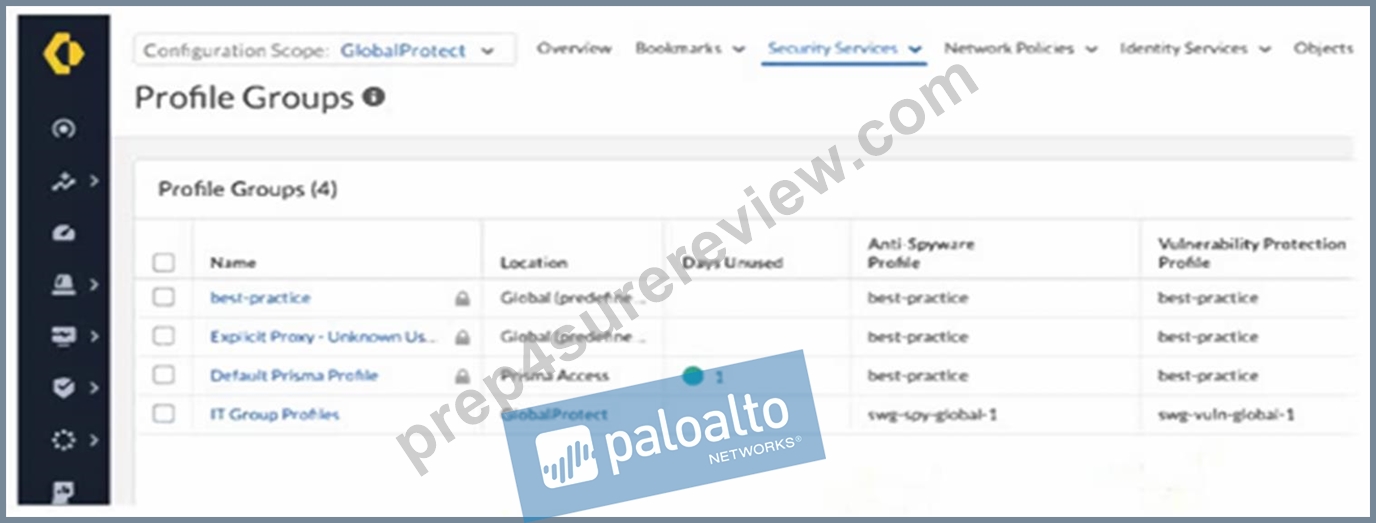
- A. Create a new profile, because default profile groups cannot be modified.
- B. Request edit access for the GlobalProtect scope.
- C. Modify the existing anti-spyware profile, because best-practice profiles cannot be removed from a group.
- D. Change the configuration scope to Prisma Access and modify the profile group.
Answer: A
Explanation:
Palo Alto Networks best practices and the behavior of Strata Cloud Manager (SCM) dictate thatpredefined or default objects, including profile groups like "Default Prisma Profile," cannot be directly modified.
These default objects serve as baseline configurations and are often locked to prevent accidental or unintended changes that could impact the overall security posture.
The intern's experience of the options being greyed out when selecting "Default Prisma Profile" is a direct indication of this immutability of default objects.
Therefore, the correct action is to:
* Create a new Profile Group:The intern should create a new profile group within the appropriate configuration scope (likely GlobalProtect, given the task).
* Configure the new Profile Group:In this new profile group, the intern can select the desired Anti- Spyware Profile (which might be an existing custom profile or a new one they create).
* Modify Security Rules:The security rules currently using the "Default Prisma Profile" in the GlobalProtect folder need to be modified to use this newly created profile group.
Let's analyze why the other options are incorrect based on official documentation:
* A. Request edit access for the GlobalProtect scope.While having the correct scope permissions is necessary for makinganychanges within GlobalProtect, it will not override the inherent immutability of default objects like "Default Prisma Profile." Edit access will allow the intern to create new objects and modify rules, but not directly edit the default profile group.
* B. Change the configuration scope to Prisma Access and modify the profile group.The image shows that "Default Prisma Profile" has a "Location" of "Prisma Access." However, even within the Prisma Access scope, default profile groups are generally not directly editable. The issue is not the scope but the fact that it's a default object.
* D. Modify the existing anti-spyware profile, because best-practice profiles cannot be removed from a group.The question is about changing theprofile group, not the individual Anti-Spyware Profile. While "best-practice" profiles might be part of default groups, the core issue is the inability to modify thedefault groupitself. Creating a new group allows the intern to choose which Anti-Spyware Profile to include.
In summary, the fundamental principle in Palo Alto Networks management is that default objects are typically read-only to ensure a consistent and predictable baseline. To make changes, you need to create custom objects.
NEW QUESTION # 15
When using the traffic replication feature in Prisma Access, where is the mirrored traffic directed for analysis?
- A. Strata Cloud Manager (SCM)
- B. Dedicated cloud storage location
- C. Panorama
- D. Specified internal security appliance
Answer: D
Explanation:
Palo Alto Networks documentation clearly states that when configuring the traffic replication feature in Prisma Access, you mustspecify an internal security applianceas the destination for the mirrored traffic.
This appliance, typically a Palo Alto Networks next-generation firewall or a third-party security tool, is responsible for receiving and analyzing the replicated traffic for various purposes like threat analysis, troubleshooting, or compliance monitoring.
Let's analyze why the other options are incorrect based on official documentation:
* B. Dedicated cloud storage location:While Prisma Access logs and other data might be stored in the cloud, themirrored trafficfor real-time analysis is directly streamed to a designated security appliance, not a passive storage location.
* C. Panorama:Panorama is the centralized management system for Palo Alto Networks firewalls. While Panorama can receive logs and manage the configuration of Prisma Access, it is not the direct destination for real-time mirrored traffic intended for immediate analysis.
* D. Strata Cloud Manager (SCM):Strata Cloud Manager is the platform used to configure and manage Prisma Access. It facilitates the setup of traffic replication, including specifying the destination appliance, but it does not directly receive or analyze the mirrored traffic itself.
Therefore, the mirrored traffic from the traffic replication feature in Prisma Access is directed to a specified internal security appliance for analysis.
NEW QUESTION # 16
Which statement applies when enabling multitenancy in Prisma Access (Managed by Panorama)?
- A. Each tenant is allocated its own dedicated Prisma Access instances, with compute resources that are not shared across tenants.
- B. There is flexibility to manage different tenants using separate Panoramas, which allows for better organization and management of the multiple tenants.
- C. Service connection licenses will be assigned only to the first tenant, and these service connections can be shared with the other tenants.
- D. A single tenant cannot consist solely of mobile users or solely of remote networks.
Answer: A
Explanation:
When multitenancy is enabled in Prisma Access (Managed by Panorama), a key characteristic is the isolation of resources between tenants. Palo Alto Networks documentation emphasizes that each tenant operates within its own logically separate Prisma Access environment. This includes dedicated compute instances, ensuring that the performance and security of one tenant are not impacted by the activities of another.
Let's analyze why the other options are incorrect based on official documentation:
A: Service connection licenses will be assigned only to the first tenant, and these service connections can be shared with the other tenants. This statement is incorrect. In a multitenant Prisma Access deployment, licenses are typically managed and allocated per tenant. While the underlying infrastructure might be shared by Palo Alto Networks, the logical resources and often the licensing are segmented for each tenant. Sharing service connections across completely separate tenants would violate the principle of tenant isolation.
B: A single tenant cannot consist solely of mobile users or solely of remote networks. This statement is incorrect. Prisma Access multitenancy allows for flexibility in how tenants are configured. A tenant can be designed to exclusively serve mobile users, exclusively connect remote networks, or a combination of both, depending on the organizational structure and requirements.
D: There is flexibility to manage different tenants using separate Panoramas, which allows for better organization and management of the multiple tenants. While it is possible to have multiple Panorama instances managing different parts of a large infrastructure, when discussing multitenancy within a single Prisma Access instance (as implied by the question "enabling multitenancy in Prisma Access (Managed by Panorama))", all configured tenants are managed by that single Panorama instance. Managing different tenants with separate Panoramas is a different architectural consideration, not a defining characteristic of enabling multitenancy within one Prisma Access deployment managed by a specific Panorama.
Therefore, the defining characteristic of Prisma Access multitenancy (Managed by Panorama) is the allocation of dedicated Prisma Access instances and compute resources for each tenant, ensuring logical separation and resource isolation
NEW QUESTION # 17
Based on the image below, which two statements describe the reason and action required to resolve the errors? (Choose two.)
- A. Create a do not decrypt rule for the hostname "google.com."
- B. The client is misconfigured.
- C. Create a do not decrypt rule for the hostname "certificates.godaddy.com."
- D. The server has pinned certificates.
Answer: A,D
Explanation:
The error messages indicate that Prisma Access is encountering certificate issues while attempting to decrypt traffic to "google.com." This suggests that theserver has pinned certificates, meaning it does not allow man- in-the-middle (MITM) decryption by Prisma Access. Since pinned certificates prevent traffic decryption, a solution is tocreate a "do not decrypt" rule for the hostname "google.com."This will allow traffic to flow without triggering certificate errors while maintaining secure communication with Google's servers.
NEW QUESTION # 18
All mobile users are unable to authenticate to Prisma Access (Managed by Strata Cloud Manager) using SAML authentication through the Cloud Identity Engine. Users report that after entering their credentials on the Identity Provider (IdP) login page, they are redirected to the Prisma Access portal without successful authentication, and they receive this error message:
Error: Prisma Access Portal Authentication Failed using CIE-SAML with message "400 Bad Request" Which action will identify the root cause of this error?
- A. Examine the Security policy rules in Prisma Access to ensure that traffic from the IdP is allowed and not blocked.
- B. Verify the SAML metadata configuration in both Strata Cloud Manager and the IdP portal to confirm that the endpoint URLs and certificates are correctly configured.
- C. Review the Authentication logs in Strata Cloud Manager to check for any SAML error messages or authentication failures.
- D. Verify the SAML metadata configuration in both the Cloud Identity Engine and the IdP portal to confirm that the endpoint URLs and certificates are correctly configured.
Answer: D
Explanation:
The"400 Bad Request"error when attemptingSAML authenticationthrough theCloud Identity Engine (CIE)suggests amisconfiguration in the SAML metadata. This typically occurs when theendpoint URLs, certificates, or entity IDsdo not match betweenCloud Identity Engine and the IdP portal. To resolve this, verify that:
TheSAML metadatauploaded toCloud Identity Enginematches theconfiguration from the IdP.
TheACS (Assertion Consumer Service) URL, Entity ID, and certificateare correctly set.
There are no incorrect or expired certificates in theCloud Identity Engine and IdP configuration.
By ensuring theSAML metadatais properly configured inboth systems, authentication should proceed without errors.
NEW QUESTION # 19
A customer is implementing Prisma Access (Managed by Strata Cloud Manager) to connect mobile users, branch locations, and business-to- business (B2B) partners to their data centers.
The solution must meet these requirements:
The mobile users must have internet filtering, data center connectivity, and remote site connectivity to the branch locations.
The branch locations must have internet filtering and data center connectivity.
The B2B partner connections must only have access to specific data center internally developed applications running on non-standard ports.
The security team must have access to manage the mobile user and access to branch locations.
The network team must have access to manage only the partner access.
How should Prisma Access be implemented to meet the customer requirements?
- A. Deploy a Prisma Access instance with mobile users, remote networks, and private access for all connection types, and use the Prisma Access Configuration scope to manage all access.
- B. Deploy two Prisma Access instances - the first with mobile users, remote networks, and private access for all internal connection types, and the second with remote networks and private application access for B2B connections - and use the specific configuration scope for the connection type to manage access.
- C. Deploy two Prisma Access instances - the first with mobile users, remote networks, and private access for all internal connection types, and the second with remote networks and private application access for B2B connections - and use the Strata Multitenant Cloud Manager Prisma Access configuration scope to manage access.
- D. Deploy a Prisma Access instance with mobile users, remote networks, and private access for all connection types, and use the specific configuration scope for the connection type to manage access.
Answer: B
Explanation:
To meet the customer's requirements, two separate Prisma Access instances should be deployed:
* Instance 1should includemobile users, remote networks, and private accessfor internal connectivity.
This ensures that mobile users can access the internet, data centers, and remote branch locations while enforcing security policies.
* Instance 2should be configured withremote networks and private application accessfor B2B connections. This instance will restrict access to only the required internally developed applications using non-standard ports, ensuring that partners cannot access other corporate resources.
By usingspecific configuration scopes for different connection types, the security team can manage access to mobile users and branch locations, while the network team can manage B2B partner connections. This ensuresproper segmentation of management responsibilitieswhile maintaining security and compliance.
NEW QUESTION # 20
Where are tags applied to control access to Generative AI when implementing AI Access Security?
- A. To user devices for identifying and controlling which Generative AI applications they can access
- B. To security rules for defining which types of Generative AI applications are allowed or blocked
- C. To Generative AI URL categories for classifying trusted and untrusted Generative AI websites
- D. To Generative AI applications for identifying sanctioned, tolerated, or unsanctioned applications
Answer: D
Explanation:
When implementingAI Access Security,tagsare applied toGenerative AI applicationsto classify them as sanctioned, tolerated, or unsanctioned. This allows organizations to enforcepolicy-based access control over AI tools, ensuring that onlyapproved applicationsare accessible while restricting or monitoring usage of untrusted or high-risk AI platforms. This classification helps security teamsmanage AI-related risks and complianceeffectively.
NEW QUESTION # 21
During a deployment of Prisma Access (Managed by Strata Cloud Manager) for mobile users, a SAML authentication type and authentication profile in the Cloud Identity Engine application is successfully created.
Using this SAML authentication, what is a valid next step to configure authentication for mobile users?
- A. In Strata Cloud Manager, create a new authentication type of "Cloud Identity Engine."
- B. Permit the Cloud Identity Engine service account RBAC access to the mobile user folder in Strata Cloud Manager.
- C. Perform a full commit to Strata Cloud Manager so the Cloud Identity Engine profiles get synchronized from the application.
- D. Create a SAML authentication profile in Strata Cloud Manager and link it to the Cloud Identity Engine profile.
Answer: D
Explanation:
After successfully creating aSAML authentication type and authentication profileinCloud Identity Engine
, the next step is toconfigure a corresponding SAML authentication profile in Strata Cloud Managerand link it to theCloud Identity Engine profile. This ensures thatPrisma Access (Managed by Strata Cloud Manager)can authenticate mobile users using the configured SAML identity provider (IdP), enabling seamless user authentication and access control.
NEW QUESTION # 22
Which feature can help address a customer concern about the length of time it takes to update their SaaS- allowed IP addresses while onboarding to Prisma Access?
- A. Dedicated IP addresses
- B. DNS-based load balancing
- C. Dynamic IP pooling
- D. Traffic steering
Answer: D
Explanation:
When onboarding toPrisma Access, usingDedicated IP addresseshelps address concerns about the time required to updateSaaS-allowed IP lists. Withdedicated egress IPs, the customer receivesfixed, predictable IP addressesthat do not change dynamically. This eliminates the need to frequently updateSaaS providers' allowlists, ensuring seamless access to cloud applications without interruptions due to IP address changes.
NEW QUESTION # 23
A customer using Prisma Access (Managed by Panorama) wants to monitor traffic patterns across all remote networks and use Strata Logging Service to gather insights on network usage. An engineer notices that some network data is missing from the Application Command Center (ACC).
What should the engineer do to ensure complete data visibility?
- A. Ensure that log forwarding profiles are applied to all Prisma Access policies and directed to Strata Logging Service.
- B. Enable the Use Data for Pre-Defined Reports' setting in the Logging and Reporting configuration on Panorama.
- C. Verify that the Panorama web interface has been configured to aggregate logs from both the Panorama data and RN-SPNs.
- D. Reconfigure the Prisma Access remote networks to log directly to Panorama instead of using Strata Logging Service.
Answer: A
Explanation:
For complete data visibility inPrisma Access (Managed by Panorama),log forwarding profilesmust be applied toall security policiesto ensure that traffic logs are correctly sent toStrata Logging Service. If log forwarding is missing or misconfigured, some traffic data may not appear in theApplication Command Center (ACC), leading to incomplete insights. Verifying and correctly assigning log forwarding ensures that all relevant network activity is captured and available for analysis.
NEW QUESTION # 24
In addition to creating a Security policy, how can an AI Access Security be used to prevent users from uploading financial information to ChatGPT?
- A. Apply File Blocking to stop file uploads containing financial information.
- B. Add the ChatGPT domains using URL Filtering to block uploads containing financial information.
- C. Apply a vulnerability profile to stop attempts to exploit system flaws or gain unauthorized access to financial systems.
- D. Configure an Enterprise DLP rule to block uploads containing financial information.
Answer: D
Explanation:
Palo Alto Networks AI Access Security integrates with Enterprise Data Loss Prevention (DLP) capabilities to control sensitive data within AI applications like ChatGPT. The most effective way to prevent users from uploading financial information is to:
* Define an Enterprise DLP rule:This rule would be configured to identify content that matches patterns or keywords associated with financial information (e.g., credit card numbers, bank account details, tax identifiers, financial statements).
* Apply the DLP rule to the AI Access Security policy:This policy would be specifically configured to inspect traffic to and from ChatGPT. When the DLP rule detects a user attempting to upload content containing financial information, it can take a defined action, such as blocking the upload.
Let's analyze why the other options are incorrect based on official documentation:
* A. Apply File Blocking to stop file uploads containing financial information.While File Blocking can prevent the upload of certain file types, it is not content-aware. It cannot inspect thecontentof a file to determine if it contains financial information. Therefore, it's not a granular or effective solution for this specific requirement.
* C. Add the ChatGPT domains using URL Filtering to block uploads containing financial information.URL Filtering controls access to specific websites or categories of websites. While you could potentially block access to ChatGPT entirely, it does not provide the capability to inspect the content being uploaded to a permitted domain and prevent the transfer of sensitive financial data.
* D. Apply a vulnerability profile to stop attempts to exploit system flaws or gain unauthorized access to financial systems.Vulnerability profiles are designed to detect and prevent attempts to exploit known security vulnerabilities in systems. They are not designed to inspect the content of user uploads for sensitive data like financial information. While importantfor overall security, they do not directly address the requirement of preventing financial data uploads to ChatGPT.
Therefore, configuring an Enterprise DLP rule within AI Access Security is the correct and most effective method to prevent users from uploading financial information to ChatGPT by inspecting the content of the uploads.
NEW QUESTION # 25
A customer is implementing Prisma Access (Managed by Strata Cloud Manager) to connect mobile users, branch locations, and business-to- business (B2B) partners to their data centers.
The solution must meet these requirements:
The mobile users must have internet filtering, data center connectivity, and remote site connectivity to the branch locations.
The branch locations must have internet filtering and data center connectivity.
The B2B partner connections must only have access to specific data center internally developed applications running on non-standard ports.
The security team must have access to manage the mobile user and access to branch locations.
The network team must have access to manage only the partner access.
Which two options will allow the engineer to support the requirements? (Choose two.)
- A. Configure the CPE with Static Routes pointing to Prisma Access Infrastructure and Mobile User routes.
- B. Configure Remote Networks and define the branch IP subnets using Static Routes.
- C. Enable eBGP for dynamic routing and configure RemoteNetworks.
- D. Enable Remote Networks Advertise Default Route.
Answer: B,C
Explanation:
Enabling eBGP for dynamic routing and configuring Remote Networks ensures seamless connectivity between branch locations, mobile users, and the data center. eBGP allows Prisma Access to dynamically exchange routes with the Customer Premises Equipment (CPE), optimizing path selection without requiring manual updates. Configuring Remote Networks and defining branch IP subnets using static routes ensures controlled and segmented routing, aligning with security policies. This setup provides proper internet filtering, data center connectivity, and restricted access for B2B partners while keeping management responsibilities aligned.
NEW QUESTION # 26
What must be configured to accurately report an application's availability when onboarding a discovered application for ZTNA Connector?
- A. udp ping
- B. https ping
- C. tcp ping
- D. icmp ping
Answer: C
Explanation:
When onboarding a discovered application forZTNA Connector, configuring aTCP pingallows Prisma Access to accurately report the application'savailability.TCP ping(also known as aTCP connection check) verifies whether the application's service port isopen and responsive, ensuring that the application is reachable before allowing user connections. This method is more reliable thanICMP ping, as many cloud and SaaS applicationsblock ICMP trafficfor security reasons.
NEW QUESTION # 27
When configuring Remote Browser Isolation (RBI) with Prisma Access (Managed by Strata Cloud Manager), which element is required to define the protected URLs for mobile users?
- A. A DNS Security profile applied to a Security policy with the action of "Isolate" for the target remote browser DNS categories
- B. An RBI profile applied to the URL access management profile
- C. A URL access management profile with site access set to "Isolate" applied to a Security policy
- D. A Security policy with the target URL categories and set the action to "Isolate"
Answer: C
Explanation:
When configuringRemote Browser Isolation (RBI)inPrisma Access (Managed by Strata Cloud Manager) for mobile users, aURL access management profilemust be created with thesite access action set to
"Isolate". This profile is thenapplied to a Security policyto enforce isolation for specific URLs. This ensures thatweb traffic to designated high-risk or untrusted sitesisredirected to a remote, secure browser instance, protecting endpoints from potential web-based threats.
NEW QUESTION # 28
A user connected to Prisma Access reports that traffic intermittently is denied after matching a Catch-All Deny rule at the bottom and bypassing HIP-based policies. Refreshing VPN connection restores the access.
What are two reasons for this behavior? (Choose two.)
- A. HIP-enforced policy is scheduled for certain hours of the day.
- B. Firewall loses user mapping due to missed HIP report checks.
- C. User mapping is learned from sources other than gateway authentication.
- D. "Collect HIP data' needs to be enabled in the configuration.
Answer: B,C
Explanation:
User mapping learned from sources other thangateway authenticationcan cause intermittent access issues if it conflicts with the expected user identity used in HIP-based policies. If the firewall is associatingthe user with an outdated or incorrect mapping, traffic may not match the intended security policies, leading todenials by the Catch-All Deny rule.
If thefirewall loses user mapping due to missed HIP report checks, the user may temporarily lose access to policies that require a validHost Information Profile (HIP)match. When the VPN connection is refreshed, the HIP check is re-initiated, restoring access until the issue repeats.
NEW QUESTION # 29
How can an engineer verify that only the intended changes will be applied when modifying Prisma Access policy configuration in Strata Cloud Manager (SCM)?
- A. Select the most recent job under Operations > Push Status to view the pending changes that would apply to Prisma Access.
- B. Compare the candidate configuration and the most recent version under "Config Version Snapshots/
- C. Open the push dialogue in SCM to preview all changes which would be pushed to Prisma Access.
- D. Review the SCM portal for blue circular indicators next to each configuration menu item and ensure only the intended areas of configuration have this indicator.
Answer: C
Explanation:
Palo Alto Networks documentation explicitly states that the"Preview Changes"functionality within the Strata Cloud Manager (SCM) push dialogue allows engineers to review a detailed summary of all modifications that will be applied to the Prisma Access configuration before committing the changes. This is the primary and most reliable method to ensure only the intended changes are deployed.
Let's analyze why the other options are incorrect based on official documentation:
* A. Review the SCM portal for blue circular indicators next to each configuration menu item and ensure only the intended areas of configuration have this indicator.While blue circular indicators might signify unsaved changes within a specific configuration section, they do not provide a comprehensive, consolidated view ofallpending changes across different policy areas. This method is insufficient for verifying the entirety of the intended modifications.
* B. Compare the candidate configuration and the most recent version under "Config Version Snapshots".While comparing configuration snapshots is a valuable method for understanding historical changes and potentially identifying unintended deviationsaftera push, it does not provide a real-time preview of thependingchanges before they are applied during the current modification session
* C. Select the most recent job under Operations > Push Status to view the pending changes that would apply to Prisma Access.The "Push Status" section primarily displays the status anddetails of completedorin-progresspush operations. It does not offer a preview of the changesbeforea push is initiated.
Therefore, the "Preview Changes" feature within the push dialogue is the documented and recommended method for an engineer to verify that only the intended changes will be applied when modifying Prisma Access policy configuration in Strata Cloud Manager (SCM).
NEW QUESTION # 30
......
Verified SSE-Engineer Exam Dumps Q&As - Provide SSE-Engineer with Correct Answers: https://www.prep4surereview.com/SSE-Engineer-latest-braindumps.html
SSE-Engineer Exam Questions | Real SSE-Engineer Practice Dumps: https://drive.google.com/open?id=1tuxaJ8PkIwo73DzNPt8Xg35cpdEMB54K
