
Mar 18, 2026 PASS Fortinet NSE5_FSM-6.3 EXAM WITH UPDATED DUMPS
NSE5_FSM-6.3 Questions PDF [2026] Use Valid New dump to Clear Exam
Fortinet NSE5_FSM-6.3 exam is intended for security professionals who have experience in network security and Fortinet products. NSE5_FSM-6.3 exam tests the candidate's knowledge and skills in deploying and managing FortiSIEM 6.3 in complex network environments. Fortinet NSE 5 - FortiSIEM 6.3 certification is ideal for professionals who are responsible for managing large networks, analyzing security data, and responding to security incidents.
By passing the Fortinet NSE5_FSM-6.3 certification exam, IT professionals can demonstrate their expertise in using FortiSIEM 6.3 to manage security incidents and threats effectively. Fortinet NSE 5 - FortiSIEM 6.3 certification can help professionals advance their careers in the cybersecurity industry, as it is recognized globally and highly valued in the market. Additionally, certified professionals can help organizations enhance their security posture by leveraging the full potential of FortiSIEM to detect and respond to security incidents quickly and efficiently.
NEW QUESTION # 26
Which FortiSIEM feature must you use to produce a report on which FortiGate devices in your environment are running which firmware version?
- A. Run a CMDB report
- B. Run an analytic search.
- C. Run a baseline report.
- D. Run a query using the Inventory tab.
Answer: D
Explanation:
Feature Overview: FortiSIEM provides several tools for querying and reporting on device information within an environment.
Inventory Tab: The Inventory tab is specifically designed to display detailed information about devices, including their firmware versions.
Query Functionality: Within the Inventory tab, you can run queries to filter and display devices based on specific attributes, such as the firmware version for FortiGate devices.
Report Generation: By running a query in the Inventory tab, you can produce a report that lists the FortiGate devices and their corresponding firmware versions.
References: FortiSIEM 6.3 User Guide, Inventory Management section, explains how to use the Inventory tab to query and report on device attributes.
NEW QUESTION # 27
Refer to the exhibit.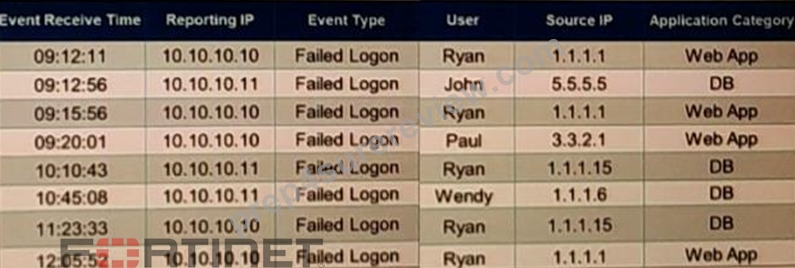
If events are grouped by Reporting IP, Event Type, and user attributes in FortiSIEM, how ,many results will be displayed?
- A. Five results will be displayed.
- B. Seven results will be displayed.
- C. Unique attribute cannot be grouped.
- D. There results will be displayed.
Answer: B
Explanation:
* Grouping Events: Grouping events by specific attributes allows for the aggregation of similar events.
* Grouping Criteria: For this question, events are grouped by "Reporting IP," "Event Type," and "User."
* Unique Combinations Analysis:
10.10.10.10, Failed Logon, Ryan, 1.1.1.1, Web App
10.10.10.11, Failed Logon, John, 5.5.5.5, DB
10.10.10.10, Failed Logon, Ryan, 1.1.1.1, Web App (duplicate, counted as one unique result)
10.10.10.10, Failed Logon, Paul, 3.3.2.1, Web App
10.10.10.11, Failed Logon, Ryan, 1.1.1.15, DB
10.10.10.11, Failed Logon, Wendy, 1.1.1.6, DB
10.10.10.10, Failed Logon, Ryan, 1.1.1.15, DB
* Result Calculation: There are seven unique combinations based on the specified grouping attributes.
* Reference: FortiSIEM 6.3 User Guide, Event Management and Reporting sections, explaining how events are grouped and reported based on selected attributes.
NEW QUESTION # 28
When configuring collectors located in geographically separated sites, what ports must be open on a front end firewall?
- A. HTTPS, from the Internet to the collector and from the collector to the FortiSIEM cluster
- B. HTTPS, from the collector to the worker upload settings address only
- C. HTTPS, from the collector to the supervisor and worker upload settings addresses
- D. HTTPS,from the Internet to the collector
Answer: C
Explanation:
FortiSIEM Architecture: In FortiSIEM, collectors gather data from various sources and send this data to supervisors and workers within the FortiSIEM architecture.
Communication Requirements: For collectors to effectively send data to the FortiSIEM system, specific communication channels must be open.
Port Usage: The primary port used for secure communication between the collectors and the FortiSIEM infrastructure is HTTPS (port 443).
Network Configuration: When configuring collectors in geographically separated sites, the HTTPS port must be open for the collectors to communicate with both the supervisor and the worker upload settings addresses.
This ensures that the collected data can be securely transmitted to the appropriate processing and analysis components.
References: FortiSIEM 6.3 Administration Guide, Network Ports section details the necessary ports for communication within the FortiSIEM architecture.
NEW QUESTION # 29
An administrator is using SNMP and WMI credentials to discover a Windows device. How will the WMI method handle this?
- A. WMI method will collect only DHCP logs.
- B. WMI method will collect only DNS logs.
- C. WMI method will collect security, application, and system events logs.
- D. WMI method will collect only traffic and IIS logs.
Answer: C
Explanation:
WMI Method: Windows Management Instrumentation (WMI) is a set of specifications from Microsoft for consolidating the management of devices and applications in a network.
Log Collection: WMI is used to collect various types of logs from Windows devices.
* Security Logs: Contains records of security-related events such as login attempts and resource access.
* Application Logs: Contains logs generated by applications running on the system.
* System Logs: Contains logs related to the operating system and its components.
Comprehensive Data Collection: By using WMI, FortiSIEM can gather a wide range of event logs that are crucial for monitoring and analyzing the security and performance of Windows devices.
References: FortiSIEM 6.3 User Guide, Data Collection Methods section, which details the use of WMI for collecting event logs from Windows devices.
NEW QUESTION # 30
Consider the storage of anomaly baseline date that is calculated for different parameters. Which database is used for storing this data?
- A. Profile DB
- B. CMDB
- C. SVNDB
- D. Event DB
Answer: B
Explanation:
Anomaly Baseline Data: Anomaly baseline data refers to the statistical profiles and baselines calculated for various parameters to detect deviations indicative of potential security incidents.
Profile DB: The Profile DB is specifically designed to store such baseline data in FortiSIEM.
* Purpose: It maintains statistical profiles for different monitored parameters to facilitate anomaly detection.
* Usage: This data is used by FortiSIEM to compare real-time metrics against the established baselines to identify anomalies.
References: FortiSIEM 6.3 User Guide, Database Architecture section, which describes the different databases used in FortiSIEM and their purposes, including the Profile DB for storing anomaly baseline data.
NEW QUESTION # 31
Which process converts raw log data to structured data?
- A. Data parsing
- B. Data classification
- C. Data validation
- D. Data enrichment
Answer: A
Explanation:
Raw Log Data: When devices send logs to FortiSIEM, the data arrives in a raw, unstructured format.
Data Parsing Process: The process that converts this raw log data into a structured format is known as data parsing.
* Data Parsing: This involves extracting relevant fields from the raw log entries and organizing them into a structured format, making the data usable for analysis, reporting, and correlation.
Significance of Structured Data: Structured data is essential for effective event correlation, alerting, and generating meaningful reports.
References: FortiSIEM 6.3 User Guide, Data Parsing section, which details how raw log data is transformed into structured data through parsing.
NEW QUESTION # 32
Which command displays the Linux agent status?
- A. Service fsm-linux-agent status
- B. Service fortisiem-linux-agent status
- C. Service Aa-linux-agent status
- D. Service linux-agent status
Answer: B
NEW QUESTION # 33
In which state can a device be moved into the CMDB to prevent monitoring log collection?
- A. Unmanaged
- B. Pending
- C. Unapproved
- D. Void
Answer: A
NEW QUESTION # 34
Refer to the exhibit.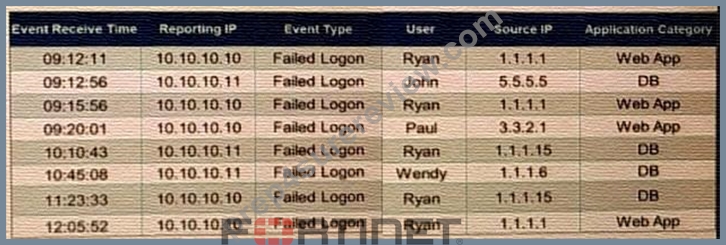
If events are grouped by Reporting IP, Event Type, and user attributes in FortiSIEM, how ,many results will be displayed?
- A. Five results will be displayed.
- B. Seven results will be displayed.
- C. Unique attribute cannot be grouped.
- D. There results will be displayed.
Answer: B
Explanation:
Grouping Events: Grouping events by specific attributes allows for the aggregation of similar events.
Grouping Criteria: For this question, events are grouped by "Reporting IP," "Event Type," and "User." Unique Combinations Analysis:
* 10.10.10.10, Failed Logon, Ryan, 1.1.1.1, Web App
* 10.10.10.11, Failed Logon, John, 5.5.5.5, DB
* 10.10.10.10, Failed Logon, Ryan, 1.1.1.1, Web App(duplicate, counted as one unique result)
* 10.10.10.10, Failed Logon, Paul, 3.3.2.1, Web App
* 10.10.10.11, Failed Logon, Ryan, 1.1.1.15, DB
* 10.10.10.11, Failed Logon, Wendy, 1.1.1.6, DB
* 10.10.10.10, Failed Logon, Ryan, 1.1.1.15, DB
Result Calculation: There are seven unique combinations based on the specified grouping attributes.
References: FortiSIEM 6.3 User Guide, Event Management and Reporting sections, explaining how events are grouped and reported based on selected attributes.
NEW QUESTION # 35
Refer to the exhibit.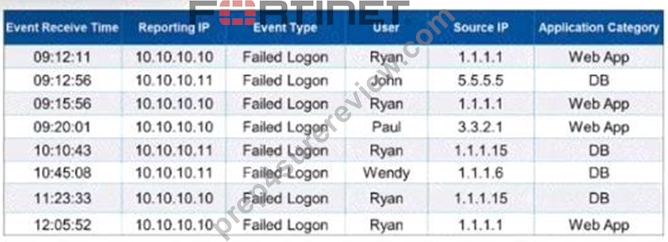
It events are grouped by Event Type and User attributes in FortiSIEM. how many results will be displayed?
- A. Eight results will be displayed.
- B. Four results will be displayed.
- C. No results will be displayed.
- D. Two results will be displayed.
Answer: A
Explanation:
Grouping Events in FortiSIEM: Grouping events by specific attributes allows administrators to aggregate and analyze data more efficiently.
Grouping Criteria: In this case, the events are grouped by "Event Type" and "User" attributes.
Unique Combinations: To determine the number of results displayed, identify the unique combinations of the "Event Type" and "User" attributes in the provided data.
* Failed Logon by Ryan(appears multiple times but is one unique combination)
* Failed Logon by John
* Failed Logon by Paul
* Failed Logon by Wendy
Unique Groupings: There are four unique groupings based on the given data: "Failed Logon" by "Ryan",
"John", "Paul", and "Wendy".
References: FortiSIEM 6.3 User Guide, Event Management and Reporting sections, which explain how events are grouped and reported based on selected attributes.
NEW QUESTION # 36
What are the minimum memory requirements for the FortiSIEM supervisor virtual appliance, when the proprietary flat file database is used?
- A. 64G8 RAM
- B. 32GB RAM
- C. 16G8 RAM
- D. 24GB RAM
Answer: D
NEW QUESTION # 37
Device discovery information is stored in which database?
- A. Profile DB
- B. CMDB
- C. SVN DB
- D. Event DB
Answer: B
Explanation:
Device Discovery Information: Information about discovered devices, including their configurations and statuses, is stored in a specific database.
CMDB: The Configuration Management Database (CMDB) is used to store detailed information about the devices discovered by FortiSIEM.
* Function: It maintains comprehensive details about device configurations, relationships, and other metadata essential for managing the IT infrastructure.
Significance: Storing discovery information in the CMDB ensures that the FortiSIEM system has a centralized repository of device information, facilitating efficient management and monitoring.
References: FortiSIEM 6.3 User Guide, Configuration Management Database (CMDB) section, which details the storage and usage of device discovery information.
NEW QUESTION # 38
Which is a requirement for implementing FortiSIEM disaster recovery?
- A. SNMP, and WMI ports must be open between the two supervisor nodes.
- B. All worker nodes must access both supervisor nodes using IP.
- C. DNS names must be used for the worker upload addresses.
- D. The two supervisor nodes must have layer 2 connectivity.
Answer: C
Explanation:
Disaster Recovery (DR) Implementation: For FortiSIEM to effectively support disaster recovery, specific requirements must be met to ensure seamless failover and data integrity.
Layer 2 Connectivity: One of the critical requirements for implementing FortiSIEM DR is that the two supervisor nodes must have layer 2 connectivity.
* Layer 2 Connectivity: This ensures that the supervisors can communicate directly at the data link layer, which is necessary for synchronous data replication and other DR processes.
Importance of Connectivity: Layer 2 connectivity between the supervisor nodes ensures that they can maintain consistent and up-to-date state information, which is essential for a smooth failover in the event of a disaster.
References: FortiSIEM 6.3 Administration Guide, Disaster Recovery section, which details the requirements and configurations needed for setting up disaster recovery, including the necessity for layer 2 connectivity between supervisor nodes.
NEW QUESTION # 39
An administrator is in the process ofrenewing a FortiSIEM license. Which two commands will provide thesystem ID? (Choose two.)
- A. ./phLicenseTool-show
- B. phgetUUID
- C. phgetHWID
- D. ./phLicenseTool - support
Answer: B,C
Explanation:
License Renewal Process: When renewing a FortiSIEM license, it is essential to provide the system ID, which uniquely identifies the FortiSIEM instance.
Commands to Retrieve System ID:
* phgetHWID: This command retrieves the hardware ID of the FortiSIEM appliance.
* Usage: Run the commandphgetHWIDin the CLI to obtain the hardware ID.
* phgetUUID: This command retrieves the universally unique identifier (UUID) for the FortiSIEM system.
* Usage: Run the commandphgetUUIDin the CLI to obtain the UUID.
Verification: BothphgetHWIDandphgetUUIDare valid commands for retrieving the necessary system IDs required for license renewal.
References: FortiSIEM 6.3 Administration Guide, Licensing section details the commands and procedures for obtaining system identification information necessary for license renewal.
NEW QUESTION # 40
Which database is used for storing anomaly data, that is calculated for different parameters, such as traffic and device resource usage running averages, and standard deviation values?
- A. Profile DB
- B. CMDB
- C. SVN DB
- D. Event DB
Answer: A
Explanation:
Anomaly Data Storage: Anomaly data, including running averages and standard deviation values for different parameters such as traffic and device resource usage, is stored in a specific database.
Profile DB: The Profile DB is used to store this type of anomaly data.
* Function: It maintains statistical profiles and baselines for monitored parameters, which are used to detect anomalies and deviations from normal behavior.
Significance: Storing anomaly data in the Profile DB allows FortiSIEM to perform advanced analytics and alerting based on deviations from established baselines.
References: FortiSIEM 6.3 User Guide, Database Architecture section, which describes the purpose and contents of the Profile DB in storing anomaly and baseline data.
NEW QUESTION # 41
In me FortiSIEM CLI. which command must you use to determine whether or not syslog is being received from a network device?
- A. Onetcat
- B. OphSyslogRecorder
- C. phDeviceTest
- D. tcpdump
Answer: D
Explanation:
Syslog Reception Verification: To verify whether syslog messages are being received from a network device, a network packet capture tool can be used.
tcpdump Command:tcpdumpis a powerful command-line packet analyzer tool available in Unix-like operating systems. It allows administrators to capture and analyze network traffic.
* Usage: By usingtcpdumpwith the appropriate filters (e.g., port 514 for syslog), administrators can monitor the incoming syslog messages in real-time to verify if they are being received.
* Example Command:tcpdump -i <interface> port 514captures the syslog messages on the specified network interface.
References: FortiSIEM 6.3 User Guide, CLI Commands section, which details the usage oftcpdumpfor network traffic analysis and verification of syslog reception.
NEW QUESTION # 42
Refer to the exhibit.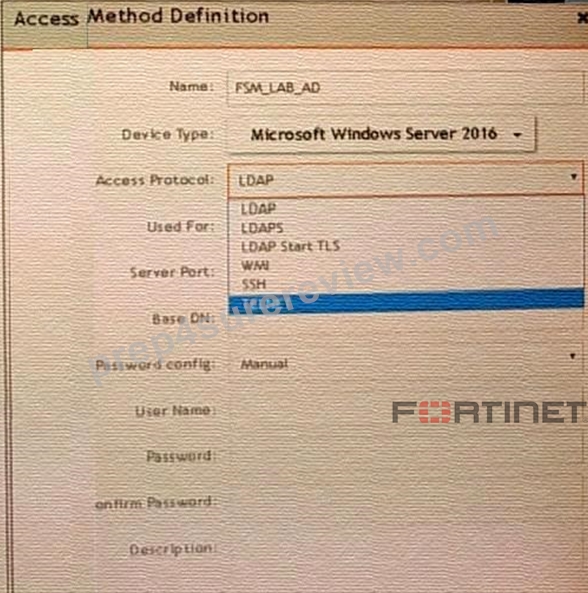
A FortiSIEM administrator wants to collect both SIEM event logs and performance and availability metrics (PAM) events from a Microsoft Windows server Which protocol should the administrator select in the Access Protocol drop-down list so that FortiSIEM will collect both SIEM and PAM events?
- A. WMI
- B. LDAP start TLS
- C. TELNET
- D. LDAPS
Answer: A
Explanation:
Collecting SIEM and PAM Events: To collect both SIEM event logs and Performance and Availability Monitoring (PAM) events from a Microsoft Windows server, a suitable protocol must be selected.
WMI Protocol: Windows Management Instrumentation (WMI) is the appropriate protocol for this task.
* SIEM Event Logs: WMI can collect security, application, and system logs from Windows devices.
* PAM Events: WMI can also gather performance metrics, such as CPU usage, memory utilization, and disk activity.
Comprehensive Data Collection: Using WMI ensures that both types of data are collected efficiently from the Windows server.
References: FortiSIEM 6.3 User Guide, Data Collection Methods section, which details the use of WMI for collecting various types of logs and performance metrics.
NEW QUESTION # 43
In me FortiSIEM CLI. which command must you use to determine whether or not syslog is being received from a network device?
- A. Onetcat
- B. OphSyslogRecorder
- C. phDeviceTest
- D. tcpdump
Answer: D
Explanation:
* Syslog Reception Verification: To verify whether syslog messages are being received from a network device, a network packet capture tool can be used.
* tcpdump Command: tcpdump is a powerful command-line packet analyzer tool available in Unix-like operating systems. It allows administrators to capture and analyze network traffic.
Usage: By using tcpdump with the appropriate filters (e.g., port 514 for syslog), administrators can monitor the incoming syslog messages in real-time to verify if they are being received.
Example Command: tcpdump -i <interface> port 514 captures the syslog messages on the specified network interface.
* Reference: FortiSIEM 6.3 User Guide, CLI Commands section, which details the usage of tcpdump for network traffic analysis and verification of syslog reception.
NEW QUESTION # 44
An administrator is using SNMP credential only for discovery of a Windows device. How will FortiSIEM handle this?
- A. FortiSIEM will apply a job to collect system event logs.
- B. FortiSIEM will apply system monitor jobs to collect resources data.
- C. FortiSIEM will apply a job to collect application event logs.
- D. FortiSIEM will apply a Job to collect security event logs
Answer: B
NEW QUESTION # 45
Which FortiSIEM components are capable of performing device discovery?
- A. Worker
- B. FortiSIEM Windows agent
- C. Collector
- D. FortiSIEM Linux agent
Answer: C
NEW QUESTION # 46
FortiSIEM is deployed in disaster recovery mode.
When disaster strikes, which two tasks must you perform manually to achieve a successful disaster recovery operation? (Choose two.)
- A. Change the configuration for shared storage NFS configured for EventDB to the secondary FortiSIEM.
- B. Promote the secondary supervisor to the primary role using the phSecondary2primary command.
- C. Change the DNS configuration to ensure that users, devices, and collectors log in to the secondary FortiSIEM.
- D. Promote the secondary workers to the primary rotes using the phSecworker2priworker command.
Answer: C,D
Explanation:
Disaster Recovery Mode: FortiSIEM's disaster recovery (DR) mode ensures that there is a backup system ready to take over in case the primary system fails.
Manual Tasks for DR Operation: In the event of a disaster, certain tasks must be performed manually to ensure a smooth transition to the secondary system.
Promoting the Secondary Supervisor:
* Use the commandphSecondary2primaryto promote the secondary supervisor to the primary role. This command reconfigures the secondary supervisor to take over as the primary supervisor, ensuring continuity in management and coordination.
Changing DNS Configuration:
* Update the DNS configuration to direct all users, devices, and collectors to the secondary FortiSIEM instance. This ensures that all components in the environment cancommunicate with the newly promoted primary supervisor without manual reconfiguration of individual devices.
References: FortiSIEM 6.3 Administration Guide, Disaster Recovery section, provides detailed steps on promoting the secondary supervisor and updating DNS configurations during a disaster recovery operation.
NEW QUESTION # 47
Which protocol is almost always required for the FortiSIEM GUI discovery process?
- A. SNMP
- B. Syslog
- C. Telnet
- D. WMI
Answer: A
NEW QUESTION # 48
How isa subparttern for a rule defined?
- A. FiltersAggregation Time Window definitions
- B. Filters Aggregation. Group By definition
- C. Filters Group By definitions. Threshold
- D. Filters Threshold Time Window definitions
Answer: A
Explanation:
Rule Subpattern Definition: In FortiSIEM, a subpattern within a rule is used to define specific conditions and criteria that must be met for the rule to trigger an incident or alert.
Components of a Subpattern: The subpattern includes the following elements:
* Filters: Criteria to filter the events that the rule will evaluate.
* Aggregation: Conditions that define how events should be aggregated or grouped for analysis.
* Time Window Definitions: Specifies the time frame over which the events will be evaluated to determine if the rule conditions are met.
Explanation: Together, these components allow the system to efficiently and accurately detect patterns of interest within the event data.
References: FortiSIEM 6.3 User Guide, Rules and Patterns section, which explains the structure and configuration of rule subpatterns, including the use of filters, aggregation, and time window definitions.
NEW QUESTION # 49
Which three ports can be used to send Syslogs to FortiSIEM? (Choose three.)
- A. TCP 514
- B. UDP 9999
- C. UDP 162
- D. TCP 1470
- E. UDP 514
Answer: A,D,E
NEW QUESTION # 50
......
Fortinet NSE5_FSM-6.3 certification is highly valued in the cybersecurity industry, as it demonstrates the candidate's proficiency in FortiSIEM. Fortinet NSE 5 - FortiSIEM 6.3 certification is recognized globally and is an excellent way for security professionals to showcase their skills and knowledge in the field of cybersecurity. Fortinet NSE 5 - FortiSIEM 6.3 certification also opens up various job opportunities for the certified professionals, including security analysts, security engineers, and security architects. Overall, the Fortinet NSE5_FSM-6.3 certification exam is an excellent way for security professionals to enhance their skills and advance their careers in the cybersecurity industry.
NSE5_FSM-6.3 Study Guide Brilliant NSE5_FSM-6.3 Exam Dumps PDF: https://www.prep4surereview.com/NSE5_FSM-6.3-latest-braindumps.html
Passing Fortinet NSE5_FSM-6.3 Exam Using 2026 Practice Tests: https://drive.google.com/open?id=1CMfKGKANMdJ9WzSpB4my0sVuSvcqVpt9
