
[Oct 09, 2025] Prepare For The VMCE_v12 Question Papers In Advance
VMCE_v12 PDF Dumps Real 2025 Recently Updated Questions
NEW QUESTION # 73
The backup administrator configured replication for a VM from Data Center 1 to Data Center 2, which runs every day at 1 a.m. A power surge takes out Data Center 1 at 7 a.m. and the administrator fails over the replica at 8 a.m. When the power comes back on, the administrator performs the "failback" action at 2 p.m. and checks the state of the original VM. They recognize that not all data is available. What is missing?
- A. Data from 7 a.m. to 8 a.m.
- B. Data from 1 a.m. to 7 a.m.
- C. Data from 1 a.m. to 2 p.m.
- D. Data from 8 a.m. to 2 p.m.
Answer: C
NEW QUESTION # 74
What transport mode does the Linux backup proxy support?
- A. Direct storage access
- B. Automatic
- C. Virtual appliance
- D. Network
Answer: C
Explanation:
Reference: https://helpcenter.veeam.com/docs/backup/vsphere/backup_proxy.html?ver=100
NEW QUESTION # 75
Veeam is being used to back up a Microsoft SQL VM with transaction logs being backed up every
30 minutes to a repository that is local to the Veeam Backup and Replication server. Business requirements dictate that the database backup and all logs also be stored on a secondary, standalone repository in the DR datacenter.
What should the Veeam engineer configure to meet the requirements?
- A. Backup Copy Job in Immediate mode
- B. Backup Copy Job in Periodic Copy mode
- C. SOBR with Copy mode enabled
- D. Backup Copy Job using the SQL Transaction Log Job as the source
Answer: A
Explanation:
You can not create a copy job for a transaction job since its a child job of the main backup job.
NEW QUESTION # 76
What is the purpose of scheduling a virtual Synthesized full backup for tape jobs?
- A. To be able to restore files and folders from tape
- B. To help save additional disk spate on tape
- C. To avoid copying a full .vbk file to tape from the source reverse incremental backup Job
- D. To be able to create the synthetic full .vbk backup directly on tape
Answer: C
NEW QUESTION # 77
A new IT director wants to institute best practices for backup management and follow the 3-2-1-1-
0 rule. The company has implemented a secondary off-site immutable copy of their backups to public cloud.
What is missing from their strategy?
- A. Three copies of data in backup
- B. One backup copy offline
- C. Automated recoverability testing
- D. Backup copies stored on two different media
Answer: C
NEW QUESTION # 78
A company is running nightly backups to satisfy their 24-hour RPO. There are two critical applications that cannot be offline more than 4 hours with no more than an hour of data loss.
How can this be accomplished?
- A. Backup copy jobs with hourly VM replication
- B. Linux hardened repository with immutability
- C. Enable Continuous Backup Replication
- D. A local SOBR with AWS Object storage
Answer: A
Explanation:
To meet the stringent Recovery Time Objective (RTO) of 4 hours and Recovery Point Objective (RPO) of 1 hour for the two critical applications, the most suitable approach is to use a combination of backup copy jobs and hourly VM replication, which corresponds to answer C.
Backup copy jobs can ensure that backups are available offsite for disaster recovery purposes, while VM replication provides the ability to quickly failover to a replica VM in case of a primary VM failure, thereby minimizing downtime. Veeam's replication capabilities are designed to create exact copies of VMs at regular intervals, which can then be rapidly activated in case of a failure.
This strategy ensures that the applications can be brought back online within the 4-hour RTO, with data loss not exceeding the 1-hour RPO, thus meeting the company's stringent data protection requirements for these critical applications.
NEW QUESTION # 79
For which workload can Veeam Data Platform achieve image-level backups?
- A. Solaris
- B. AS/400
- C. IOS
- D. IHP-UX
Answer: A
Explanation:
Veeam Data Platform can achieve image-level backups for Solaris workloads. This means it can create a complete backup of the system at the image level, capturing the entire state of the Solaris system, including the operating system, applications, and data.References:Veeam Data Platform Documentation, Veeam Solaris Backup Guide
NEW QUESTION # 80
For general data protection regulation (GDPR) compliance, Veeam can add a location tag to which component?
- A. vCenter servers
- B. Cloud gateways
- C. WAN accelerators
- D. Guest interaction proxies
Answer: A
Explanation:
Veeam Backup & Replication offers the capability to assign location tags to different components within the backup infrastructure, including vCenter servers. This feature is particularly useful for GDPR compliance, as it allows administrators to specify the physical location of the data processed and stored within vCenter servers, helping to ensure that data sovereignty and regulatory requirements are met.
NEW QUESTION # 81
A Veeam administrator has been tasked to create a backup that will automatically make a copy of data on a different media type, while also being off site, without creating additional backup or backup copy jobs. The administrator has determined that a Scale-out Backup Repository can be used as part of the solution. How can this be accomplished?
- A. Add a capacity tier to the Scale-out Backup Repository and enable the "Copy" option.
- B. Add an archive tier to the Scale-out Backup Repository and enable the "Copy" option.
- C. Add a capacity tier to the Scale-out Backup Repository and enable the "Move" option.
- D. Add an archive tier to the Scale-out Backup Repository and enable "GFS Tierinq".
Answer: A
Explanation:
By adding a capacity tier to the Scale-out Backup Repository and enabling the "Copy" option, the administrator can create a backup that automatically copies data to a different media type (object storage) and also ensures that the data is offsite. This is accomplished without creating additional backup or backup copy jobs. The "Copy" option allows for immediate copying of backups to the capacity tier, meeting the criteria specified.
NEW QUESTION # 82
Figure A shows the backup files on a Scale-out Backup Repository (SOBR) created by a single Veeam backup job. The SOBR is configured to offload to capacity tier in move mode. If the offload was completed successfully, what will remain on the performance extents for the files uploaded to the capacity tier?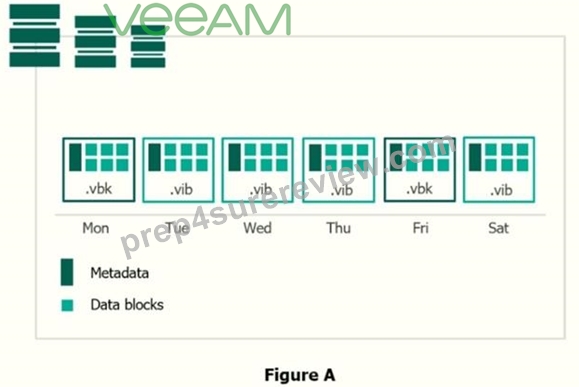
- A. VBK files (metadata and data)
- B. VIB and VBK files (data blocks only)
- C. VIB files (metadata and data)
- D. VIB and VBK files (metadata only)
- E. VBM files (metadata only)
Answer: D
NEW QUESTION # 83
For which workload can Veeam Data Platform achieve image-level backups?
- A. Solaris
- B. AS/400
- C. IOS
- D. IHP-UX
Answer: A
Explanation:
Veeam Data Platform can achieve image-level backups for Solaris workloads. This means it can create a complete backup of the system at the image level, capturing the entire state of the Solaris system, including the operating system, applications, and data.
NEW QUESTION # 84
A Veeam engineer is using on-premises object storage as the primary storage for backups. What can the engineer create to make sure the backups conform to the 3-2-1 rule?
- A. A backup copy job to send the backups to public cloud object storage.
- B. A snapshot of the primary storage periodically.
- C. A file copy job to create a copy on a NAS device in the same data center.
- D. A copy of the backups to tape and store them in the same building.
Answer: A
Explanation:
https://www.veeam.com/blog/321-backup-rule.html
NEW QUESTION # 85
In the event a VMware VM configuration file (VMX) is missing and a restore is needed, what Veeam restore process is the best choice for this situation?
- A. Virtual disk restore
- B. VM file restore
- C. Instant VM recovery
- D. Instant disk recovery
Answer: B
Explanation:
https://helpcenter.veeam.com/docs/backup/vsphere/vmfile_recovery.html?ver=100
NEW QUESTION # 86
Veeam Backup and Replication is currently configured with backup jobs that are targeting a local Backup Repository on a Windows Server.
The backups are now configured to run periodically every 6 hours. The engineer wants to create a secondary copy of the backups. However, due to bandwidth and compute restrictions, the copies must be created and transferred only once a day.
Which option should the engineer choose to achieve this goal?
- A. Configure a Hardened Linux Repository, create a Backup Copy job with Periodic Copy (Pruning) mode to this repository and schedule it to run once a day
- B. Add the repository to a Scale-Out Backup repository, extend it with a Public Cloud Object Storage as Capacity tier in copy and move mode, and set the operational restore window to 7 days
- C. [Add the repository to a Scale-Out Backup repository, extend it with a Public Cloud Object Storage as Capacity tier in copy mode
- D. Find a Service Provider with Offsite Backup services, create a Backup Copy job with Immediate Copy (Mirroring) mode to the Service Provider repository
Answer: A
Explanation:
To achieve the goal of creating a secondary copy of the backups that is transferred only once a day, the engineer should configure a Hardened Linux Repository and create a Backup Copy job with Periodic Copy (Pruning) mode to this repository, scheduling it to run once a day. This setup respects the bandwidth and compute limitations while ensuring a daily copy of the backups.References:Veeam Backup & Replication User Guide, Veeam Backup Copy Job Configuration Guide
NEW QUESTION # 87
What is the primary benefit of configuring replica mapping?
- A. Compressed WAN traffic
- B. Reduced WAN traffic
- C. Encrypted WAN traffic
- D. Deduplicated WAN traffic
Answer: B
NEW QUESTION # 88
A business has the following new regulatory requirements to follow:
- Follow the 3-2-1 rule.
- Prevent the most recent 31 days of any backup files from being
deleted or modified
- Keep one copy of a monthly restore point around for two years
They have the following setup:
- A standalone repository on a NAS
- A backup job keeping 31 days of restore points
- A backup copy job to an Amazon Simple Storage Service Repository,
keeping 31 days of backups and 24 monthly GFS restore points
Which two actions should the engineer take to change the environment to meet the new requirements? (Choose two.)
- A. Enable immutability in Amazon S3
- B. Move the backups from the NAS to a hardened repository
- C. Enable Immutability on the NAS
- D. Add 24 monthly GFS restore points to the backup job
- E. Configure a Scale-Out Backup Repository with NAS and Windows hardened repository
Answer: A,B
Explanation:
Based on the new requirements, the two most appropriate changes are:
Move the backups from the NAS to a hardened repository (option D)
To meet the requirement of preventing modifications or deletions for the most recent 31 days, you need an immutable (WORM) storage target. A standard NAS typically doesn't provide immutability, so moving to a hardened (Linux) repository enables that 31-day lock on local backups.
Enable immutability in Amazon S3 (option E)
For the offsite (copy) backups, you also need to protect them from deletions or modifications for the same 31-day window. By configuring Object Lock (immutability) on the S3 bucket, you ensure the copy is similarly protected.
NEW QUESTION # 89
A backup administrator is deploying a Veeam ONE environment. They have chosen to use separate servers from their Veeam Backup & Replication environment. What benefit will they receive if they install the Veeam ONE Agent onto their backup server?
- A. Track whether VMs and agents are properly protected and following the 3-2-1 rule
- B. Collect Veeam Backup & Replication logs and execute remediation actions
- C. Collect virtual environment configuration from Veeam Backup & Replication
- D. Analyze Veeam Backup & Replication log data and retrieve signature updates
Answer: C
NEW QUESTION # 90
Why is it recommended to install Veeam ONE before Veeam Backup & Replication?
- A. Veeam ONE can verify that the server meets the minimum requirements to install Veeam Backup & Replication.
- B. Veeam ONE is a prerequisite for Veeam Backup & Replication installation.
- C. Veeam ONE can potentially identify infrastructure issues prior to performing a backup.
- D. Veeam ONE stores the license file necessary for Veeam Backup & Replication.
Answer: C
Explanation:
It is recommended to install Veeam ONE before Veeam Backup & Replication because Veeam ONE can potentially identify infrastructure issues that might affect backup operations before they are performed. This proactive approach ensures that the environment is optimized for successful backup and replication tasks.References:Veeam Installation and Configuration Guide, Veeam ONE Deployment Best Practices
NEW QUESTION # 91
......
Veeam VMCE_v12 Exam Syllabus Topics:
| Topic | Details |
|---|---|
| Topic 1 |
|
| Topic 2 |
|
| Topic 3 |
|
| Topic 4 |
|
| Topic 5 |
|
| Topic 6 |
|
| Topic 7 |
|
| Topic 8 |
|
| Topic 9 |
|
| Topic 10 |
|
| Topic 11 |
|
| Topic 12 |
|
| Topic 13 |
|
VMCE_v12 Dumps and Practice Test (162 Exam Questions): https://www.prep4surereview.com/VMCE_v12-latest-braindumps.html
Released Veeam VMCE_v12 Updated Questions PDF: https://drive.google.com/open?id=1mbZVuSVAVSlEW6pg8yHcIDlW0sJwjXIp
