
Pass Fortinet FCP_FMG_AD-7.6 Exam Quickly With Prep4SureReview
Prepare FCP_FMG_AD-7.6 Question Answers - FCP_FMG_AD-7.6 Exam Dumps
NEW QUESTION # 26
Refer to the exhibits.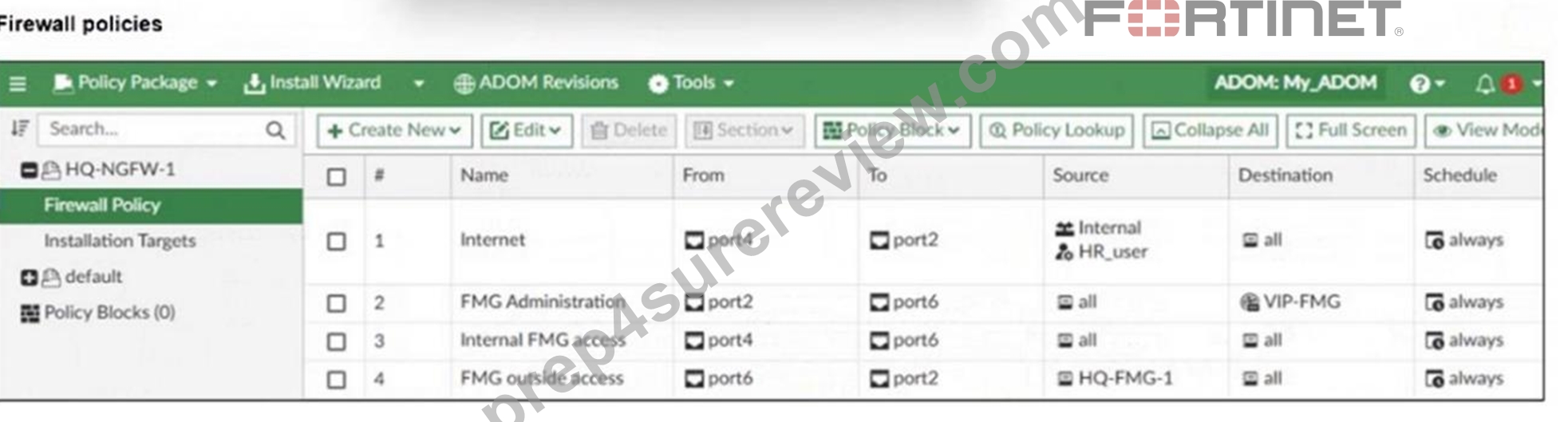

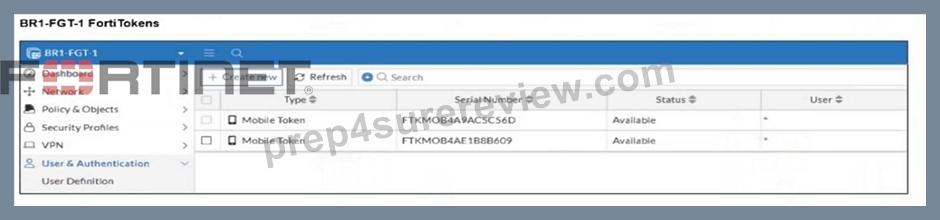
An administrator needs to push a FortiToken Mobile to assign it to HR_user in the HQ-NGFW-1.
However, when installing the policy package, they receive the following error message: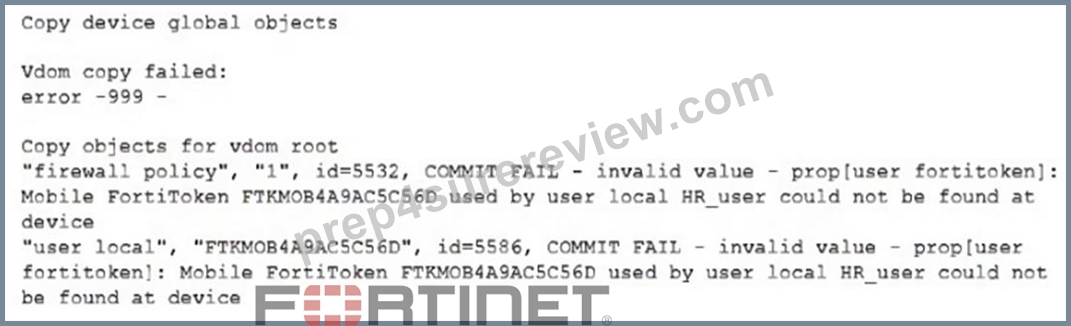
Why is the administrator not able to install the FortiToken on the HQ-NGFW-1 firewall?
- A. The administrator must use a user local meta field to assign FortiToken.
- B. The administrator must use a valid FortiToken that exists on HQ-NGFW-1.
- C. The administrator must use a metadata variable to assign the same FortiToken to multiple users in FortiManager.
- D. The administrator must use per-device mapping to assign the FortiToken to HQ-NGFW-1.
Answer: B
Explanation:
The error occurs because the FortiToken used (FTKM0B4A9AC5C56D) must already exist and be registered on the FortiGate device HQ-NGFW-1. FortiManager cannot push or create new FortiTokens on the device; the token must be valid and present on the FortiGate before it can be assigned to a user.
NEW QUESTION # 27
Which two statements about the integrity of databases on FortiManager are correct? Choose two answers.
- A. Scheduled backups run database integrity commands automatically.
- B. The diagnose cdb check adom-integrity command can correct issues related to locked devices.
- C. Not following the correct upgrade path may cause inconsistencies in the databases.
- D. You should fix all database integrity issues before performing a script.
- E. The diagnose dvm check-integrity command attempts to fix a corrupted file system.
Answer: A,C
Explanation:
The correct answers are A and E . The study guide explicitly states under Database Integrity that scheduled backups "Automatically executes database integrity commands" and "Does not automatically make corrections" . That exactly verifies A .
It also states in Best Practices-Database Integrity: "Always follow the proper upgrade path" and "If you don't, it may cause inconsistencies in the database." That exactly verifies E .
B is incorrect because diagnose dvm check-integrity verifies and corrects device manager database issues such as device states, memberships, lock statuses, and duplicate VDOM entries, not a corrupted file system. C is incorrect because locked device status issues are listed under diagnose dvm check-integrity, not diagnose cdb check adom-integrity. D is not a stated FortiManager best practice in the uploaded guide.
NEW QUESTION # 28
Refer to the exhibit. An administrator created two new meta fields in FortiManager.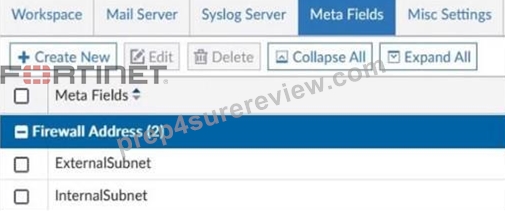
Which operation can you perform with these parameters?
- A. You can invoke them using the $ character.
- B. You can use them as variables in scripts.
- C. You can export them to be used in other ADOMs.
- D. You can add them to objects as custom attributes.
Answer: D
Explanation:
Meta fields in FortiManager can be added to objects as custom attributes, allowing administrators to categorize and add additional information to firewall objects for easier management and identification.
NEW QUESTION # 29
Refer to the exhibit. If the monitored interface for the primary FortiManager device fails, what must you do to maintain high availability (HA)?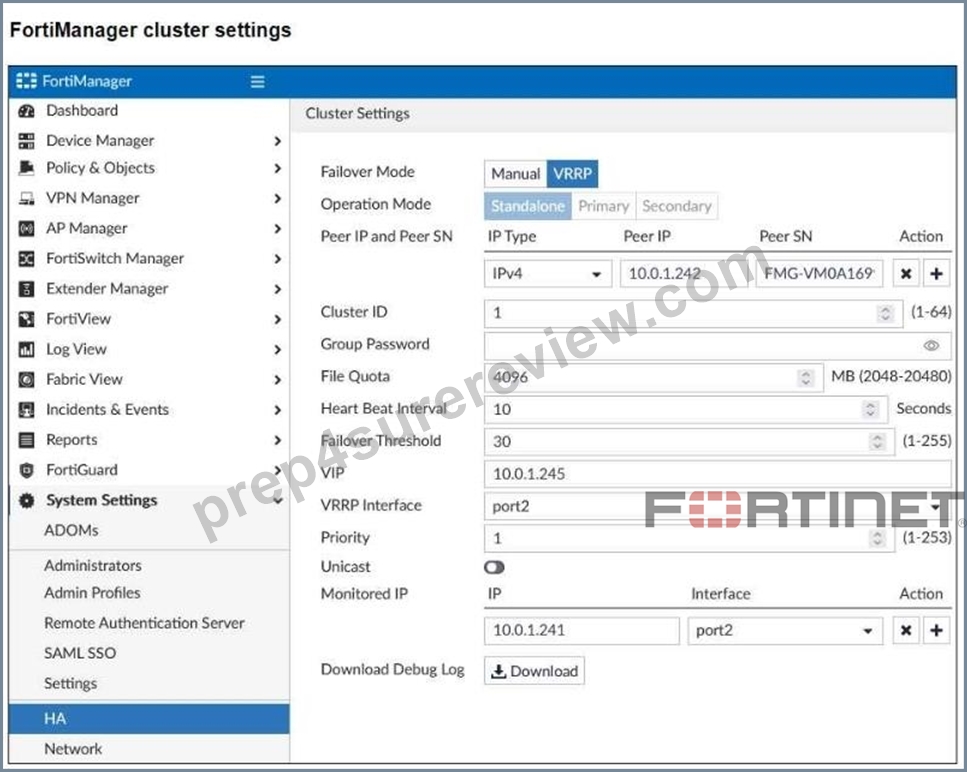
- A. Check the integrity database of the primary device to force a secondary device to become the new primary with all active interfaces.
- B. Reconfigure the primary device to remove the peer IP address of the failed device from its configuration.
- C. The FortiManager HA failover is transparent to administrators and does not require any additional action.
- D. Manually promote one of the working secondary devices to the primary role: and reboot the original primary device to remove the peer IP address of the failed device.
Answer: C
Explanation:
In a FortiManager HA cluster configured with VRRP failover, the failover process is automatic and transparent to administrators. If the monitored interface on the primary device fails, the secondary device takes over without requiring manual intervention to maintain HA.
NEW QUESTION # 30
A FortiManager administrator opens the revision history and choose to revert to a previous version.
What will this action do to the current device configuration?
- A. It will trigger an unknown device-level database status, and the administrator will have to import a policy package to sync.
- B. It will modify the device-level database.
- C. It will revert both configurations: device-level database and policy layer database.
- D. It will trigger a conflict status if it is using any provisioning template, and the administrator will have to install changes.
Answer: B
Explanation:
When you revert to a previous ADOM revision in FortiManager, the device-level database (which contains configuration settings specific to the managed device) will be modified to match the version you reverted to. This action restores the device configuration from that revision, effectively undoing any changes made since that point in time.
NEW QUESTION # 31
What is the purpose of ADOM revisions?
- A. ADOM revisions show specific changes in a policy package when it is installed.
- B. ADOM revisions save the current state of all policy packages and objects for an ADOM.
- C. ADOM revisions compare previous snapshots of the Policy Package and ADOM-level objects with the device-level database.
- D. ADOM revisions find unused, duplicate, and unnecessary firewall policies and objects.
Answer: B
Explanation:
ADOM revisions save the current state of all policy packages and objects within an ADOM, allowing administrators to track changes over time and revert to previous configurations if needed.
NEW QUESTION # 32
Refer to Exhibit: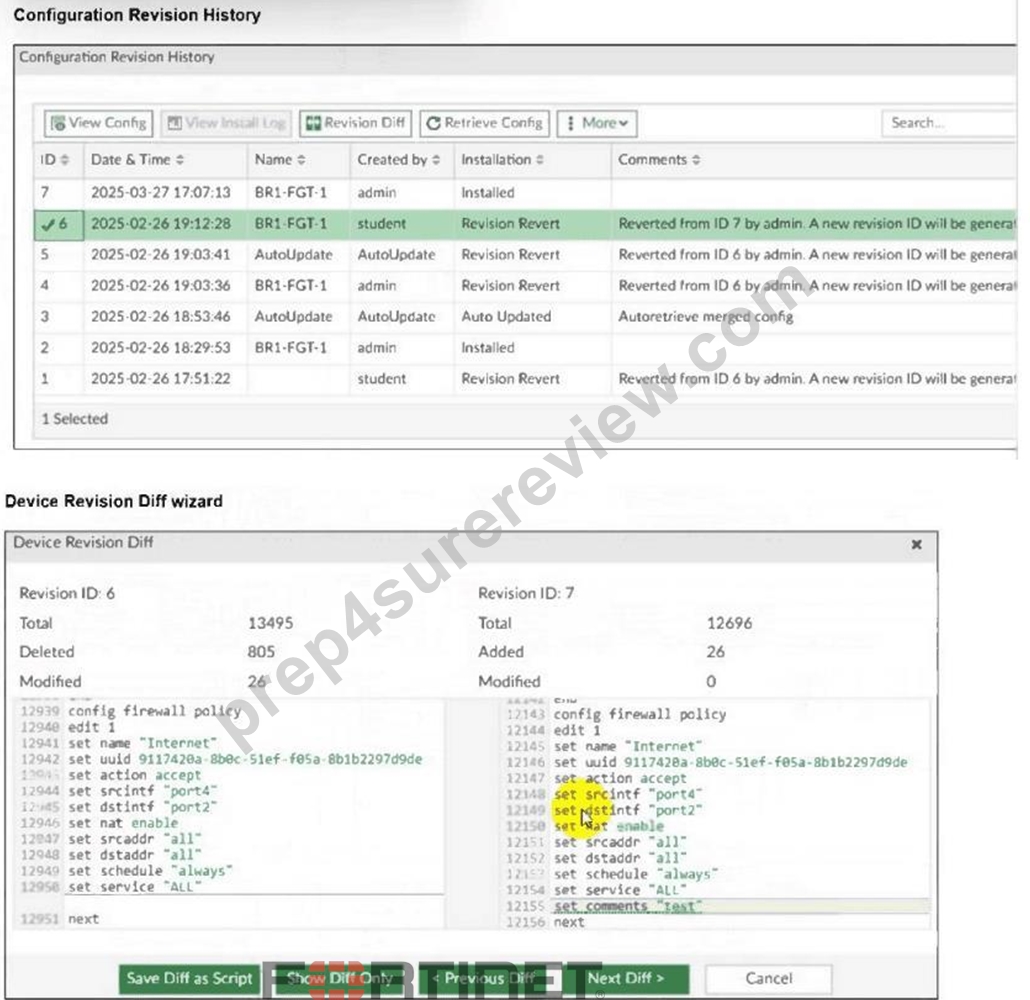
An administrator admin used the Configuration Revision History window to revert the FortiGate device configuration to revision ID 6. After running the reinstall policy package, the administrator noticed problems with the firewall policy- they could not see the unset comment on policy ID 1.
Why did FortiManager not remove the comment from policy ID 1 when the administrator ran reinstall policy package?
- A. Because every time the administrator uses the revert config file, they must use the Install Wizard instead of running the reinstall policy package.
- B. Because the administrator used the Revision Diff view, which shows what changed, not what will be installed.
- C. Because the administrator student must install the configuration changes to correctly see the expected results.
- D. Because the administrator must import the firewall policies to update the firewall policy package.
Answer: D
Explanation:
The correct answer is B . The FortiManager 7.6 Administrator Study Guide gives the exact extract:
"Performing a revert operation followed by an installation only reverts device-level changes and does not revert policy packages. To achieve full synchronization, you must run the Import Configuration tool on FortiManager to synchronize the policy package." The guide also states: "After every retrieve, auto-update, or revert operation, you must use Import Configuration to ensure the policy information is synchronized." In the exhibit, the missing unset comment for policy ID 1 is a policy package issue, not just a device-level revert issue. Reinstalling the existing policy package does not automatically rebuild it from the reverted revision. The administrator must import the firewall policies again so the policy package reflects the reverted policy state. That is why the comment was not removed.
=========
NEW QUESTION # 33
Refer to the exhibit. An administrator added a FortiGate device to FortiManager with the default object settings at the ADOM layer.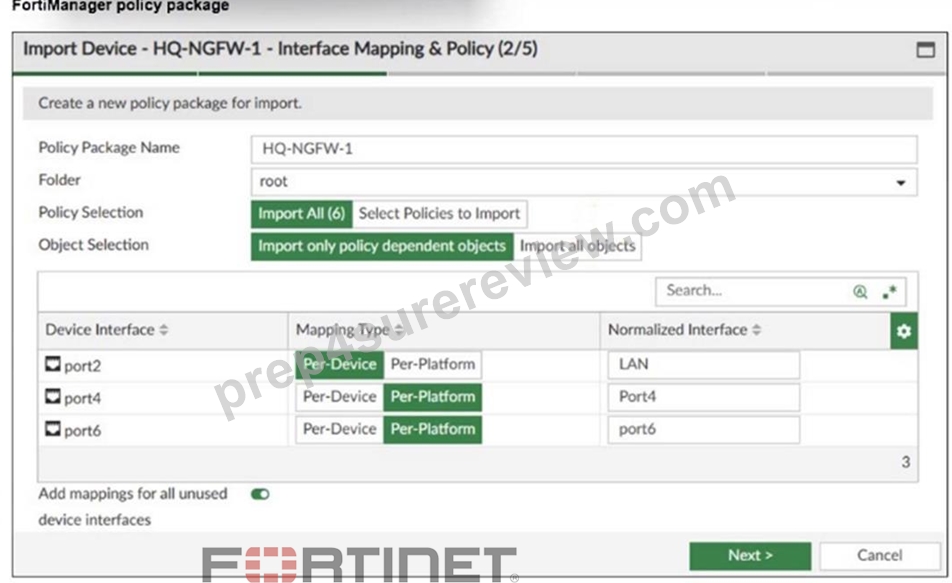
What can you conclude from the import policy package process of the HQ-NGFW- 1 device?
- A. The administrator must select Per Platform for all interfaces to correctly detect all interfaces from HQ-NGFW-1.
- B. The administrator must manually create the port4 interface on the ADOM layer to avoid import policy errors.
- C. FortiManager will create LAN, port4, and port6 as normalized interfaces at the ADOM layer.
- D. FortiGate may not work as expected when the administrator does not import all objects.
Answer: C
Explanation:
The import process shows that FortiManager will create normalized interfaces named LAN, port4, and port6 at the ADOM layer, mapping them to the corresponding device interfaces based on the import settings.
NEW QUESTION # 34
While attempting to push a NetFlow configuration script through the FortiManager policy package:
an administrator encounters an error stating that an object is unrecognized in line 4.
What must the administrator do to successfully apply the NetFlow configuration script and avoid the object unrecognized error?
- A. Create a normalized interface on the policy layer before running the script.
- B. Run the script on the device database.
- C. Make sure the user running the script has full access to the VDOM--AGEUSR.
- D. Use metadata variables if they use VDOMs in the script.
Answer: D
Explanation:
When using scripts that reference VDOM-specific objects, such as interfaces, in FortiManager, metadata variables must be used to correctly map those objects per VDOM. This prevents "object unrecognized" errors during script execution.
NEW QUESTION # 35
Refer to the exhibit.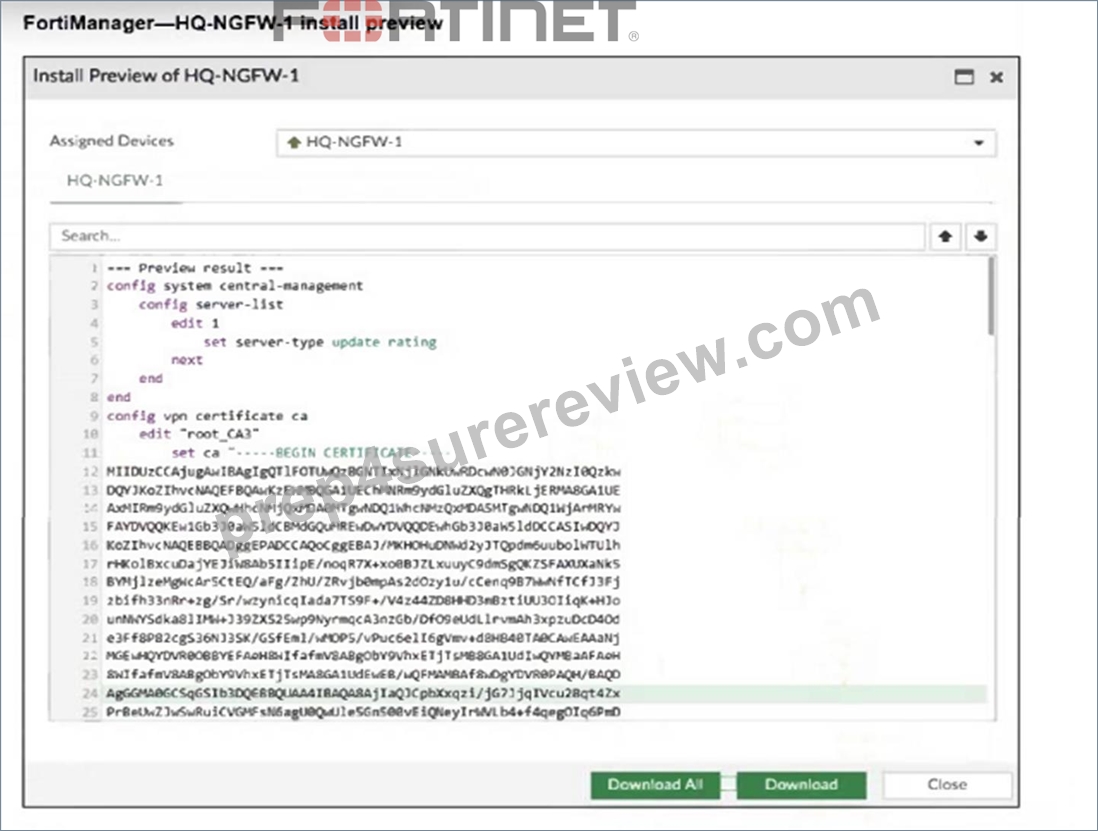
An administrator assigned a new policy package to FortiGate HQ-NGFW-1. In the installation preview, they noticed some settings they did not modify and are unsure about the changes.
Based on the exhibit, which two things will happen if they continue with the installation? (Choose two.)
- A. FortiManager will install the CA certificate named root_CA3 to authenticate FortiGate-to-FortiManager communication protocol (FGFM) tunnel connections with FortiGate HQ- NGFW-1.
- B. FortiGate HQ-NGFW-1 can use FortiManager firmware templates to upgrade firmware and ratings.
- C. FortiGate HQ-NGFW-1 can contact the FortiManager acting as FortiGuard Distribution Server (FDS) to download FortiGuard updates.
- D. FortiGate HQ-NGFW-1 will use the root_CA3 certificate in firewall address objects or policies.
Answer: A,C
Explanation:
The configuration includes a server-list with server-type set to " update rating, " which enables FortiGate HQ- NGFW-1 to contact FortiManager as a FortiGuard Distribution Server (FDS) for FortiGuard updates.
The installation includes a root_CA3 certificate, which FortiManager will install on FortiGate HQ-NGFW-1 to authenticate FGFM tunnel connections between the devices.
NEW QUESTION # 36
Refer to the exhibit. An administrator has created a firewall address object that is used in multiple policy packages for multiple FortiGate devices in an ADOM.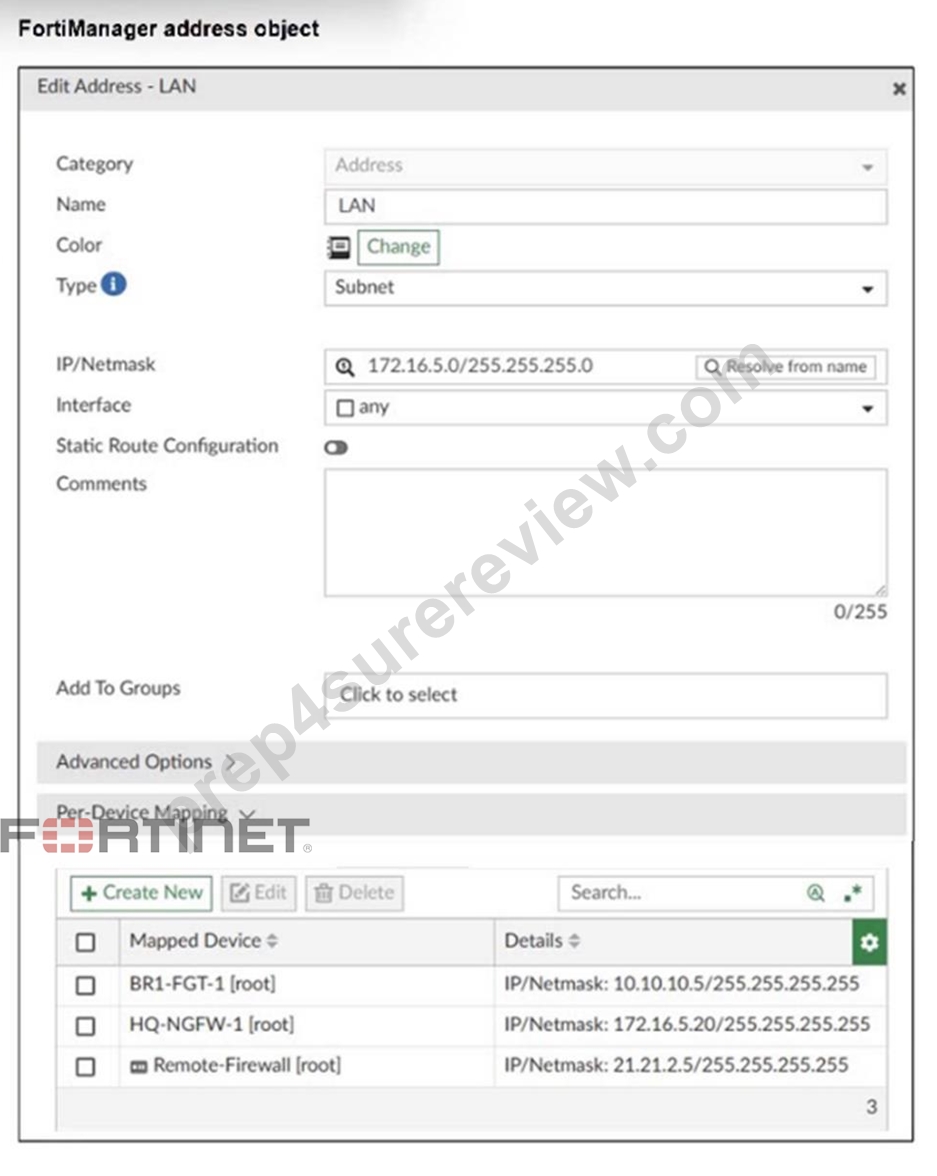
After the installation operation is performed, which IP/netmask will be installed on Remote- Firewall [VDOM1] for the LAN firewall address object?
- A. 172.16.5.0/255.255.255.0
- B. 172.16.5.20/255.255.255.255
- C. 10.10.10.5/255.255.255.255
- D. 21.21.2.5/255.255.255.255
Answer: D
Explanation:
The per-device mapping overrides the global IP/netmask setting for the firewall address object.
For the device "Remote-Firewall," the mapped IP/netmask is 21.21.2.5/255.255.255.255, so this value will be installed on Remote-Firewall [VDOM1].
NEW QUESTION # 37
Refer to the exhibit. What can you conclude from the failed installation log shown in the exhibit?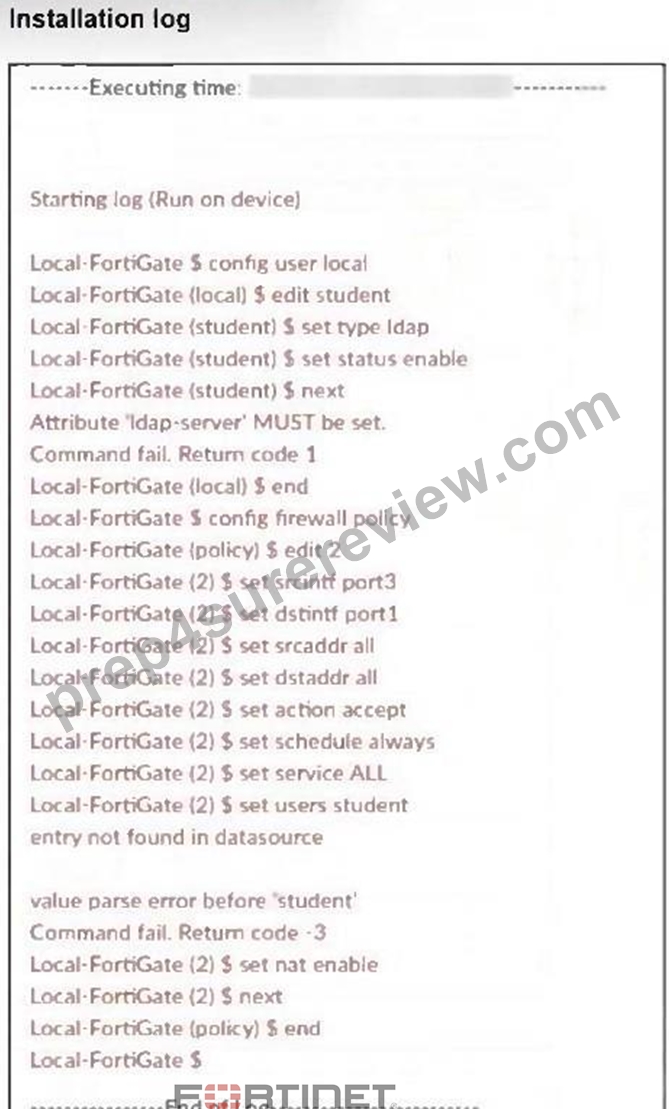
- A. Policy ID 2 will not be installed.
- B. Policy ID 2 is installed without a source address.
- C. Policy ID 2 is installed without the remote user student.
- D. Policy ID 2 is installed in the disabled state.
Answer: C
Explanation:
Similar to the case presented here, but with different end. In the guide, the policy does not install because the element "dstintf" is not set, and it's mandatory. So, the policy in the end is not installed.
However, the case in the exibit is different. Since "users" is not mandatory, and all the other elements are set, the policy will be created.
After the command "set users student" fails, we're still into the policy id 2 configuration as shown in the prompt: (2). And, after "next", there is no error message, so the policy id 2 was saved.
NEW QUESTION # 38
Refer to the exhibits. An administrator admin used the Configuration Revision History window to revert the FortiGate device configuration to revision ID 6. After running the reinstall policy package, the administrator noticed problems with the firewall policy- they could not see the unset comment on policy ID 1.
Why did FortiManager not remove the comment from policy ID 1 when the administrator ran reinstall policy package?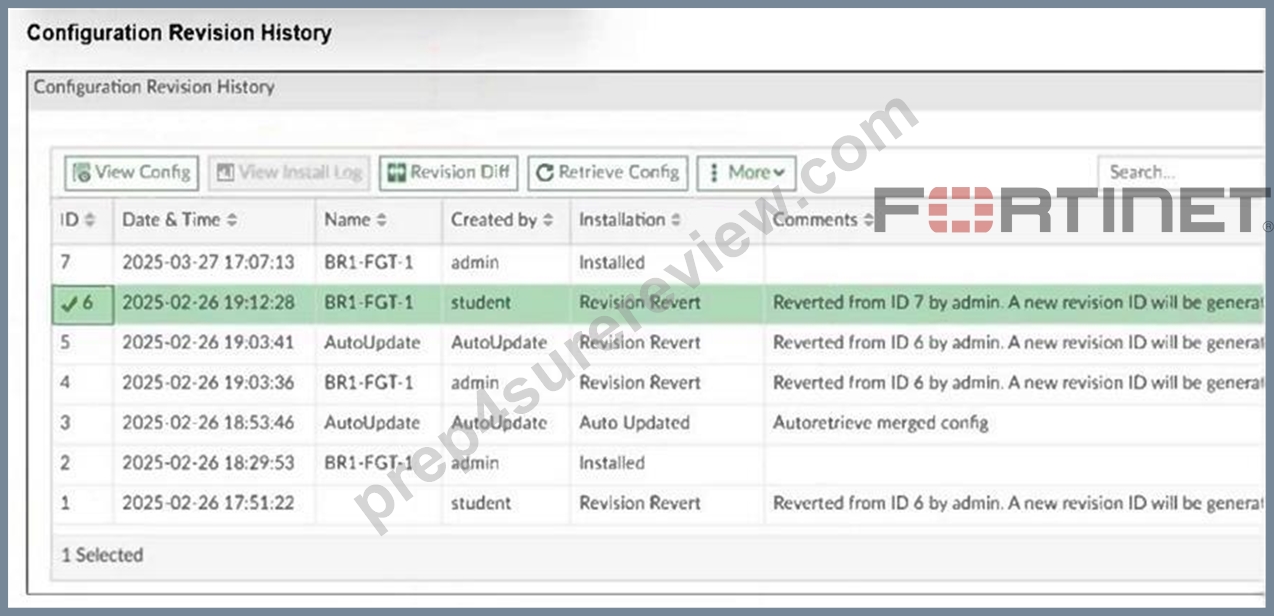
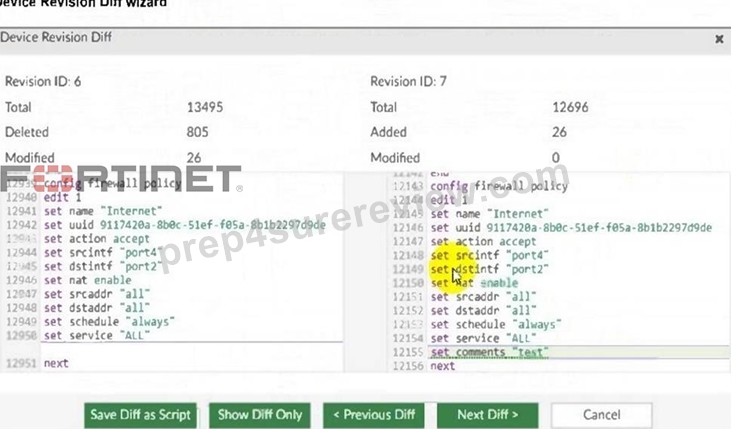
- A. Because the administrator used the Revision Diff view, which shows what changed, not what will be installed.
- B. Because the administrator student must install the configuration changes to correctly see the expected results.
- C. Because the administrator must import the firewall policies to update the firewall policy package.
- D. Because every time the administrator uses the revert configfile, they must use the Install Wizard instead of running the reinstall policy package.
Answer: C
Explanation:
Reverting the configuration on the FortiGate directly does not update FortiManager's internal policy package.
FortiManager does not automatically sync with what's on the FortiGate device after a manual configuration revert or change directly on the FortiGate.
NEW QUESTION # 39
Refer to the exhibits.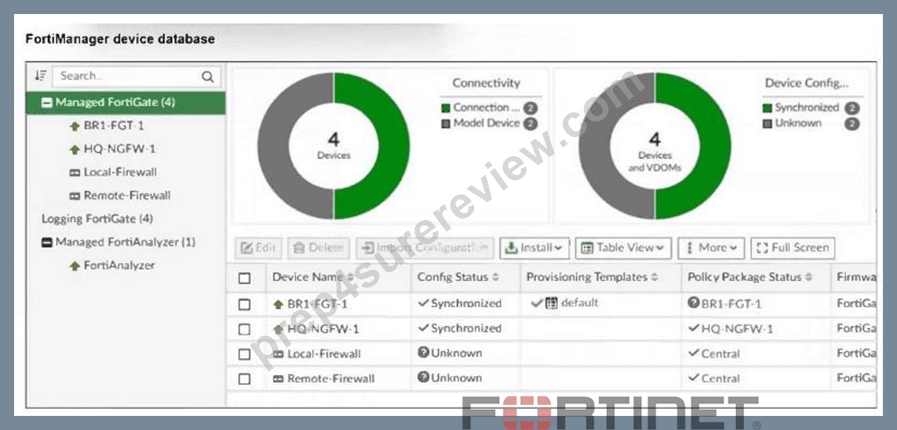
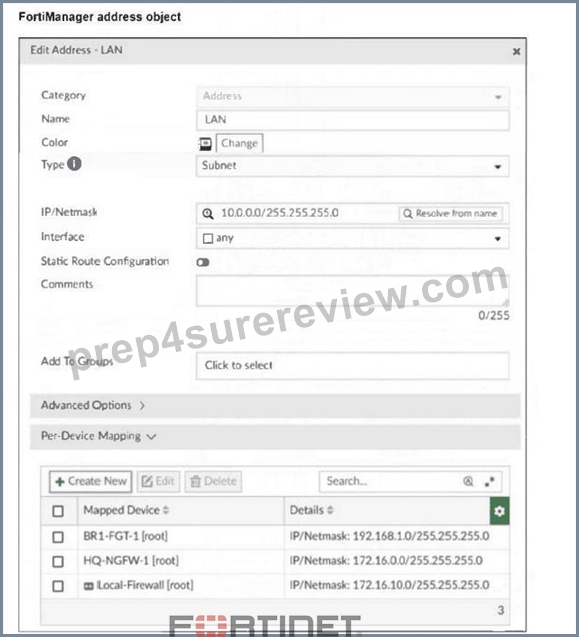
Which IP/netmask will be present in the LAN firewall address object on the Remote-Firewall?
- A. 172.16.10.0/255.255.255.0
- B. 172.16.0.0/255.255.255.0
- C. 10.0.0.0/255.255.255.0
- D. 192.168.1.0/255.255.255.0
Answer: C
Explanation:
The correct answer is B . The LAN address object shown in the exhibit has a default value of 10.0.0.0/255.
255.255.0 , and it has per-device mappings only for BR1-FGT-1 , HQ-NGFW-1 , and Local-Firewall .
There is no per-device mapping entry for Remote-Firewall .
The FortiManager 7.6 Administrator Study Guide gives the exact rule for this behavior: "The devices in the ADOM that do not have a dynamic mapping for LAN have a default value" . The same page also explains that dynamic objects let you map one logical object to unique values per device , but devices without a mapping use the object's default definition.
Since Remote-Firewall is not listed in the Per-Device Mapping table, it inherits the default LAN value:
10.0.0.0/255.255.255.0 .
=========
NEW QUESTION # 40
Refer to the exhibit.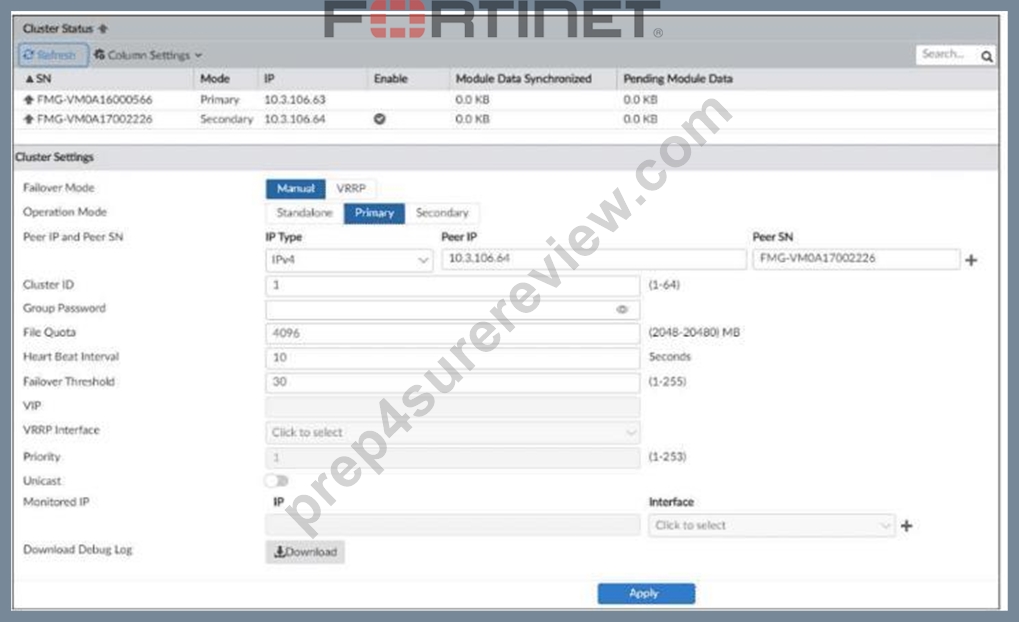
Which statement about the environment shown in the exhibit is true? Choose one answer
- A. A failover will take place after five minutes without receiving heartbeat packets.
- B. You must restart the secondary device if you promote it to primary.
- C. FortiAnalyzer features are not enabled on this FortiManager device.
- D. No FortiGuard packages have been synchronized between the cluster members.
Answer: C
Explanation:
The exhibit shows a FortiManager HA cluster with one primary and one secondary member. The FortiManager 7.6 Administrator Study Guide clearly states that if FortiAnalyzer features are enabled, you cannot configure FortiManager HA , so in an HA environment like the one shown, FortiAnalyzer features are not enabled . That makes D the correct answer.
A is incorrect because the study guide explicitly says you do not need to reboot a device when promoting it from secondary to primary.
C is incorrect because the failover mode shown is Manual , not VRRP automatic failover , so failover does not occur automatically based on heartbeat loss.
B is not the best answer here because FortiGuard packages are downloaded separately rather than synchronized as HA data, but the exhibit's key provable conclusion is the HA restriction on FortiAnalyzer features.
=========
NEW QUESTION # 41
Which two items does an FGFM keepalive message include? (Choose two.)
- A. FortiGate uptime
- B. FortiGate configuration checksum
- C. FortiGate license information
- D. FortiGate IPS version
Answer: B,D
Explanation:
Keepalive messages, including the configuration checksums, are sent from FortiGate at configured intervals.
The messages also show the intrusion prevention system (IPS) version of the FortiGate device.
NEW QUESTION # 42
Refer to the exhibits. FortiGate HQ-NGFW-1 downloads and validates FortiGuard databases from FortiManager which acts as a local FortiGuard Distribution Server (FDS) in a closed network. An administrator pushes a new firewall policy with an intrusion prevention system (IPS) profile from FortiManager to FortiGate HQ- NGFW-1 However, FortiGate does not recognize the new IPS signature from FortiManager.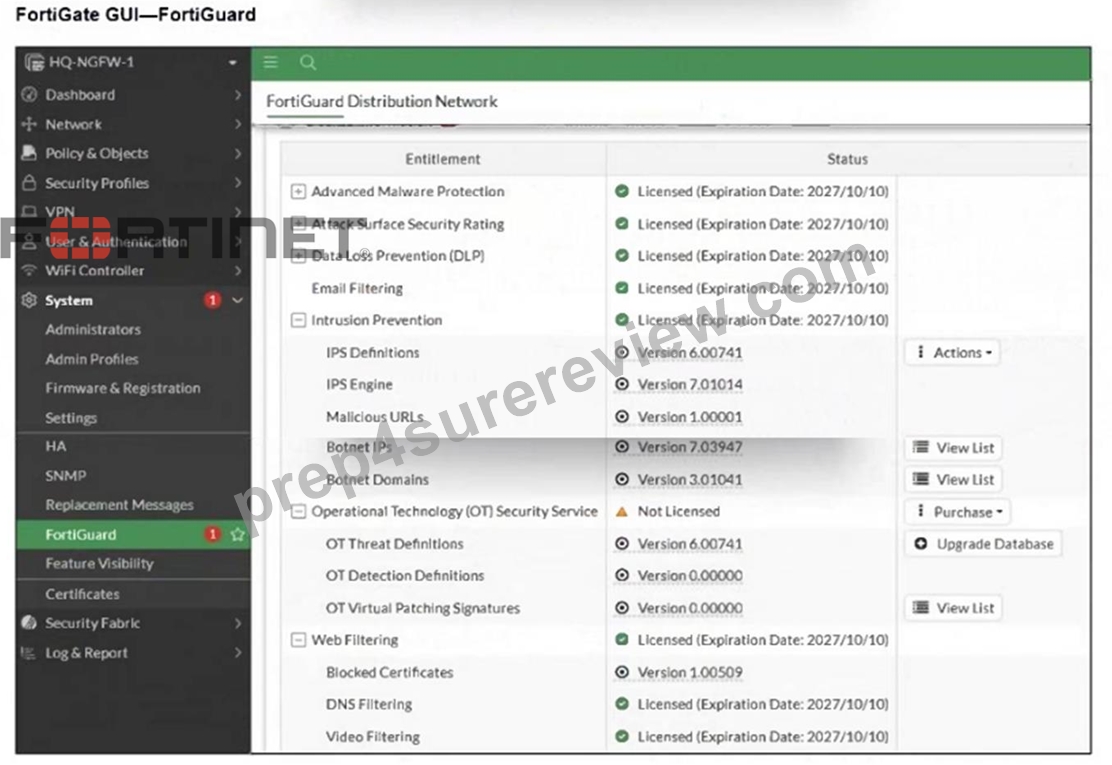
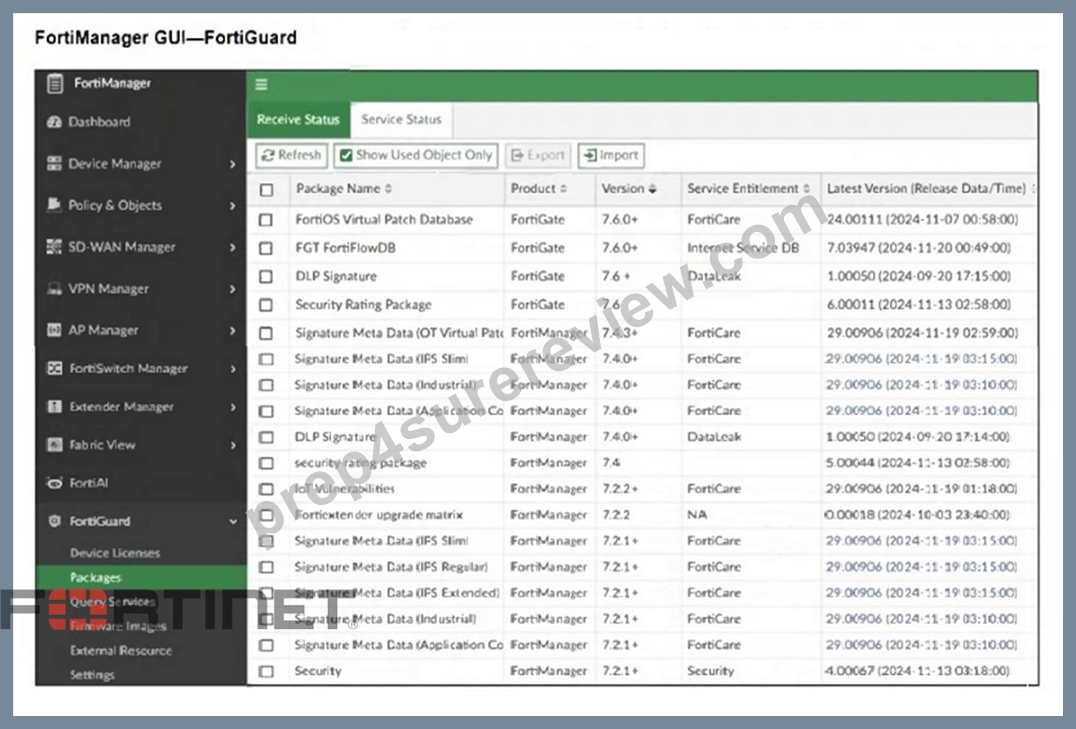
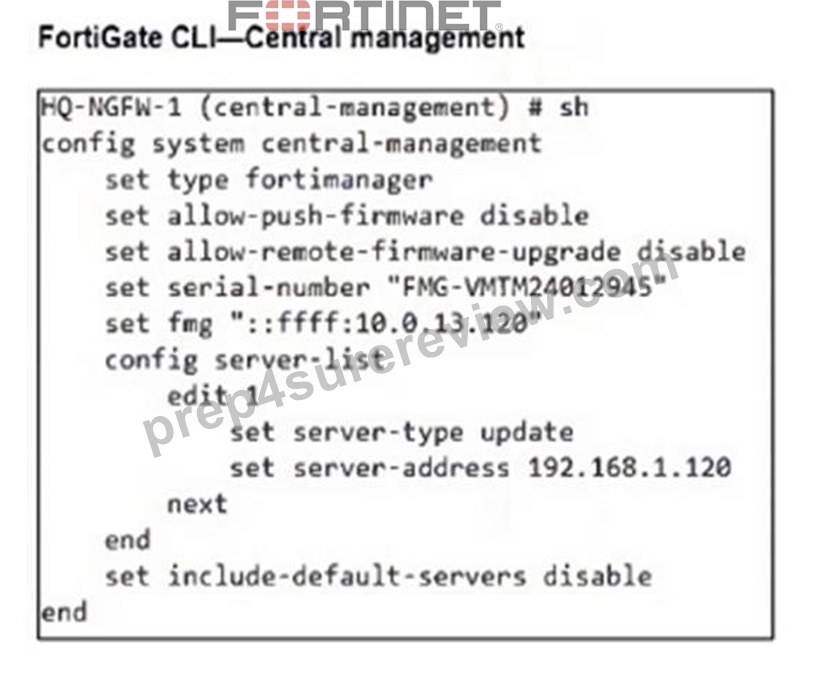
What is the most likely reason why FortiGate HQ-NGFW-1 does not recognize the new IPS signature?
- A. The administrator must enable IPv6 connections for FortiGuard services on FortiManager.
- B. FortiManager and FortiGate have different IPS database versions.
- C. FortiGate must enable rating for the FortiManager IP address, 192.168.1.120, in server list 1.
- D. The administrator must enable the fortiguard-anycast option to correctly download all signatures from the local FDS.
Answer: B
Explanation:
When FortiGate devices download IPS signatures from FortiManager acting as a local FortiGuard Distribution Server, both the FortiGate and FortiManager need to have synchronized IPS database versions to ensure compatibility. If FortiManager and FortiGate have different IPS database versions, the FortiGate will not recognize new or updated IPS signatures that were pushed from FortiManager.
NEW QUESTION # 43
......
Fortinet FCP_FMG_AD-7.6 Exam Syllabus Topics:
| Topic | Details |
|---|---|
| Topic 1 |
|
| Topic 2 |
|
| Topic 4 |
|
Real Fortinet FCP_FMG_AD-7.6 Exam Questions [Updated 2026]: https://www.prep4surereview.com/FCP_FMG_AD-7.6-latest-braindumps.html
Free FCP_FMG_AD-7.6 Exam Dumps to Pass Exam Easily: https://drive.google.com/open?id=1eqn6ty_rvUsJJ9iaY_F3bBoJA5ouo7Ko
