
Pass Your Project Management Professional PMP Exam Easily with Accurate PDF Questions [Dec 31, 2025]
PMP Certification Exam Dumps Questions in here
PMI PMP (Project Management Professional) certification exam is a globally recognized certification for project managers. Project Management Professional (2025 Version) certification exam is designed to test the knowledge and skills of project managers in the areas of project management framework, project initiation, planning, execution, monitoring, controlling, and closing. The PMI PMP certification exam is recognized as the gold standard in project management certification, and passing the exam demonstrates a high level of proficiency in project management practices.
NEW QUESTION # 1029
A project team has been together for a long time and has been led by three different project managers. Lately, the performance of one of the team members has been declining and has affected the project delivery.
What should the current project manager do to ensure that team performance is improved and sustained?
- A. Liaise with the functional managers to replace the team member.
- B. Engage with the team member and draw up a development plan.
- C. Organize quarterly team-building events.
- D. Request that a new team member be added to the team
Answer: B
NEW QUESTION # 1030
During a projects' planning phase, the high and fluctuating price of raw materials was identified as a risk After quantitative analysis of two raw materials, item A was chosen instead of item B. During the execution phase, the price of item A rises, making it more expensive than item B What should the project manager do to resolve this?
- A. Approach the procurement team.
- B. Review the cost management plan.
- C. Refer to the risk management plan.
- D. Inform the sponsor.
Answer: C
NEW QUESTION # 1031
Which is NOT an input to the Create WBS process?
- A. Project Scope Statement
- B. Scope Management Plan
- C. WBS Dictionary
- D. Organizational Process Assets
Answer: C
Explanation:
The WBS Dictionary is an output of the Create WBS process. It is created along with the WBS and gives all of the details about each work package in the WBS.
NEW QUESTION # 1032
A project manager is working on a unique project that is dissimilar to the project nature of the organization.
The project manager is tailoring the artifacts for this new project.
Who should determine which artifacts should be used in the project?
- A. The project sponsor should select the project artifacts that the project manager and project management team should use in the project.
- B. The project manager and project management team should use the standard project artifacts from the database.
- C. The project stakeholders should meet and determine the project artifacts to be used by the project manager and the project management team.
- D. The project manager and the project management team should select the appropriate artifacts for use in the specific project.
Answer: D
Explanation:
Tailoring project artifacts is a critical process in project management, particularly when dealing with unique projects that differ from an organization's usual operations. The PMBOK Guide emphasizes that artifacts should be tailored according to the nature and characteristics of the project, taking into account the applicable development approach, whether it's predictive, Agile, or hybrid1234. This tailoring process involves the project manager and the project management team selecting the appropriate artifacts that best support the project's delivery approach, deliverables, and organizational environment4. It is their responsibility to determine which artifacts are necessary and relevant for the specific project at hand, ensuring that the project' s documentation aligns with its unique requirements and goals1234.
:
PM Study Circle: "A Guide to Project Management Artifacts: PMP Exam 2024 Tips" 1 PM Study Circle: "What are Project Artifacts? Definition, Meaning, and Example" 2 Hatchett Project: "What is Project Tailoring?" 3 Project Management Academy: "Project Management Artifacts: Definition, Types, and Phases" 4
NEW QUESTION # 1033
A telecommunications company is doing a national network rollout involving continuously changing technical requirements. To address the situation the company has recently adopted a hybrid project life cycle. During a retrospective some team members complain that me majority of me stones are ready to test but have not advanced because they are waiting for the project manager's approval.
What should the project manager do?
- A. Update the issue log and review the lessons learned register for options
- B. Empower the team to self-organize and make their own decisions
- C. Implement conflict resolution to accommodate the team's needs
- D. Implement decision-making techniques to advance the stones
Answer: B
NEW QUESTION # 1034
An output of the Close Project (or Close Phase) process is:
- A. accepted deliverables
- B. work performance information
- C. project management plan updates
- D. organizational process asset updates
Answer: D
Explanation:
Section: Closing
NEW QUESTION # 1035
Before disbanding a project team, the project manager facilitates a lessons learned workshop. What should the project manager do next?
- A. Archive project documents using generally accepted practices.
- B. Perform a post-implementation review.
- C. Organize a party to celebrate the project's success.
- D. Send project documents to the stakeholders.
Answer: A
Explanation:
Section: Closing
NEW QUESTION # 1036
A project manager is assigned to a regulatory project for their country. The deadline for delivering results in compliance with the new laws is very tight, and the project team members have not yet been assigned. One of the project manager's peers informs the project manager that a project with the same scope for a different country was completed 1 year ago.
What should the project manager do first?
- A. Complete a bottom-up estimation for the project activities.
- B. Ask for additional resources and review the project estimate.
- C. Review organizational process assets (OPAs) and perform analogous estimating.
- D. Register a new risk in the risk management plan.
Answer: C
Explanation:
When faced with a tight deadline and the need to comply with new laws, the project manager should first review organizational process assets (OPAs) and perform analogous estimating. This is because OPAs can provide valuable historical information on how similar projects were executed, which can inform the current project's planning and execution. Analogous estimating, in particular, uses data from previous, similar projects to estimate project duration and cost. Given that a similar project was completed recently, this information can be used to make more accurate predictions for the current project. This approach is recommended by the PMBOKGuide as a valid method of estimation when there is limited information available and time is of the essence123.
References: The recommendation to review OPAs and perform analogous estimating is supported by the PMBOKGuide and the principles of project estimation as outlined in PMI's resources12345. Additionally, the importance of leveraging historical data for project estimation is emphasized in the Professional in Business Analysis reference materials678910.
NEW QUESTION # 1037
A company is leading a project to develop a new product using an agile approach. A supplier was contracted to provide a solution for one of the product features based on mandatory scope, stable requirements, and fixed-price contract. During a meeting with the supplier, the project manager was informed that the company's business analyst also asked the supplier to add a solution for another feature as part of their deliverable.
What should the project manager do?
- A. Monitor the work the business analyst is performing to avoid scope creep.
- B. Ensure the project team understands the agreement and contract in place with the supplier.
- C. Ask the supplier to accommodate the additional scope under the current agreement.
- D. Add the feature to the supplier's requirement list so they can deliver it.
Answer: B
Explanation:
According to the PMBOK Guide, 6th edition, section 12.2.2.4, the project manager should use procurement documentation to define and manage the contractual relationships with the suppliers. Procurement documentation includes the contract, the statement of work, the procurement management plan, and the source selection criteria. The project manager should ensure that the project team, including the business analyst, is aware of the terms and conditions of the contract and the scope of work that the supplier is expected to deliver.
Any changes or additions to the scope should be formally requested and approved through the change control process, as described in section 4.6. The PMI-PBA Guide, section 6.3.3.1, also supports this approach, as it states that the business analyst should follow the change management plan and the requirements management plan to manage changes to the requirements and to communicate them to the relevant stakeholders, including the suppliers. References:
* PMBOK Guide, 6th edition, section 12.2.2.4 and 4.6
* PMI-PBA Guide, section 6.3.3.1
According to the PMBOK Guide, 6th edition, section 12.2.2.4, the project manager should use procurement documentation to define and manage the contractual relationships with the suppliers. Procurement documentation includes the contract, the statement of work, the procurement management plan, and the source selection criteria. The project manager should ensure that the project team, including the business analyst, is aware of the terms and conditions of the contract and the scope of work that the supplier is expected to deliver.
Any changes or additions to the scope should be formally requested and approved through the change control process, as described in section 4.6. The PMI-PBA Guide, section 6.3.3.1, also supports this approach, as it states that the business analyst should follow the change management plan and the requirements management plan to manage changes to the requirements and to communicate them to the relevant stakeholders, including the suppliers. References:
* PMBOK Guide, 6th edition, section 12.2.2.4 and 4.6
* PMI-PBA Guide, section 6.3.3.1
NEW QUESTION # 1038
Correlated and contextualized information on how closely the scope is being maintained relative to the scope baseline is contained within:
- A. project documents updates.
- B. project management plan updates.
- C. change requests.
- D. work performance information.
Answer: D
Explanation:
Section: Executing
NEW QUESTION # 1039
An output of the Develop Project Team process is:
- A. Organizational charts and position descriptions.
- B. Enterprise environmental factors updates.
- C. Project staff assignments.
- D. Organizational process assets.
Answer: B
Explanation:
Section: Monitoring and Controlling
NEW QUESTION # 1040
Inputs to the Plan Risk Management process include the:
- A. risk management plan.
- B. cost management plan.
- C. risk register.
- D. activity list.
Answer: B
NEW QUESTION # 1041
A project manager is working on a project to develop a new watch at a matrix organization.
Which two key items should the project manager include in their feedback to external stakeholders? (Choose
2)
- A. Earned value in terms of schedule
- B. Schedule performance index (SPI) for the portfolio
- C. Earned value in terms of resources
- D. Expected return on investment (ROI) for portfolio projects
- E. Earned value in terms of cost
Answer: A,E
NEW QUESTION # 1042
What entity is assigned various responsibilities related to the centralized and coordinated management of those projects under its domain?
- A. Executive sponsor office
- B. Project team office
- C. Project management office
- D. Program management office
Answer: C
NEW QUESTION # 1043
Japanese resource management models exhibit.
- A. frequent changes on team assignments
- B. a cooperative spirit of goal settings
- C. 1) a cooperative spirit of goal settings, and 2) non-specialized career paths.
- D. non-specialized career paths
- E. All of the other alternatives apply.
Answer: E
NEW QUESTION # 1044
Which of the following establishes the procedures to transfer the project product or services to production and / or operations?
- A. Project files
- B. Formal acceptance documentation
- C. Administrative closure procedure
- D. Contract closure procedure
Answer: C
NEW QUESTION # 1045
The following is a network diagram for a project.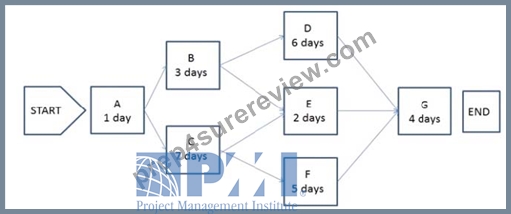
The critical path for the project is how many days in duration?
- A. Explanation:
UESTION NO: 50
A graphic display of project team members and their reporting relationships is known as a:
A.Resource calendar.
B.Project organization chart.
C.Resource breakdown structure (RBS).
D.Responsibility assignment matrix (RAM). - B. 0
- C. 1
- D. 2
- E. 3
Answer: A,E
NEW QUESTION # 1046
Sensitivity analysis can be used in risk analysis to:
- A. Substitute for uncertainty analysis in risk quantification and estimate the level of risk aversion adopted by management
- B. All of the other alternatives apply.
- C. estimate the level of risk aversion adopted by management
- D. estimate the effect of change of one project variable on the overall project
- E. Substitute for uncertainty analysis in risk quantification
Answer: D
NEW QUESTION # 1047
To ease the workload on the acceptance testing team a key stakeholder request that intermediate project milestones be delivered in a sequence different than that outlined in the original project plan. What should the project manager do first?
- A. Issue a change request to document the request change.
- B. Update the project plan with the reordered intermediate program milestones..
- C. Recalculate the project's critical path to determine the impact of the request
- D. Inform all stakeholders of the request
Answer: C
NEW QUESTION # 1048
A customer asks the project manager to estimate the time required to include a missing functionality. The customer thinks that three days will be sufficient to implement this change. However, the project management office (PMO) believes that seven days are required, while the technical lead feels that 10 days are needed.
What should the project manager use to estimate the time required for the change?
- A. Pareto diagram analysis
- B. Analogous estimating
- C. Beta distribution
- D. Parametric estimating
Answer: C
NEW QUESTION # 1049
During the closing process, the project manager learns that one deliverable is not meeting customer expectations.
How should the project manager proceed?
- A. Meet with the customer to reach agreement on the scope of the deliverable that will satisfy both parties
- B. Contact the project sponsor and ask for help in negotiating the closing of the project with the customer
- C. Ask the customer to issue a change request with the information to analyze and provide a solution
- D. Review the deliverable requirements, check the customer approval criteria, and proceed accordingly
Answer: D
NEW QUESTION # 1050
Assume you are working as the project manager on the first project in your company to use the critical chain approach to scheduling. You are a PMP ® and also are certified in critical chain. You are getting ready for a performance review with your Governance Board, and you can expect they will ask questions about______________
- A. Schedule risk
- B. Performance to date since the past review meeting
- C. The buffer needed and buffer remaining
- D. The magnitude of variance against the schedule baseline
Answer: C
Explanation:
Explanation/Reference:
Explanation:
Critical chain is an approach in scheduling in which the project team can place buffers on any project schedule path to account for limited resources and project uncertainties. During a performance review, comparing the amount of buffer remaining to the amount of buffer needed to protect the delivery date can help to determine schedule status.
NEW QUESTION # 1051
......
Verified PMP dumps Q&As 100% Pass in First Attempt Guaranteed Updated Dump: https://drive.google.com/open?id=1SNUV5BYKQ0_VNCY1Ev-jO_Nh1oDkolit
Updated PMP Exam Practice Test Questions: https://www.prep4surereview.com/PMP-latest-braindumps.html
