
[Sep-2025] VMware 2V0-32.22 Exam Practice Test Questions - Prep4SureReview
Updated Certification Exam 2V0-32.22 Dumps - Practice Test Questions
NEW QUESTION # 38
What is a use case for vRealize Operations in a hybrid cloud infrastructure?
- A. Infrastructure as a service automaton and governance
- B. Central log collector for public clouds
- C. Holistic network visibility across overlay and physical networks with detailed information about Cisco switches and NSX-T
- D. Unified visibility across on-premises environments and public clouds
Answer: D
Explanation:
A key use case for vRealize Operations in a hybrid cloud infrastructure is providing unified visibility across on-premises environments and public clouds . It can monitor and manage both on-premises vSphere environments and public cloud platforms like AWS and Azure, offering a centralized view of performance, capacity, and health across the entire hybrid infrastructure
NEW QUESTION # 39
A user is assigned the CloudAdmin role in a VMware Cloud on AWS software-defined data center (SDDC). At which level in the inventory hierarchy can the user deploy virtual machines?
- A. Compute-ResourcePool in the Hosts and Clusters view
- B. vsanDatastore in the Storage view
- C. Discovered virtual machine folder in the VMs and Templates view
- D. Mgmt-ResourcePool in the Hosts and Clusters view
Answer: C
Explanation:
This would enable the user to have the necessary permissions to deploy virtual machines - and thus, would ensure that all of the necessary virtual machines are deployed in a timely and efficient manner.
VMware Cloud on AWS Documentation: "Deployment of virtual machines"
VMware Cloud on AWS Documentation: "Creating virtual machines with the VMware Cloud on AWS console" VMware Cloud on AWS Documentation: "Managing virtual machines with the VMware Cloud on AWS console"
NEW QUESTION # 40
A cloud administrator is In the process of troubleshooting a non-compliant object.
How can the administrator change a VM storage policy for an ISO image?
- A. Modify the default VM storage policy and recreate the ISO image.
- B. Modify the default VM storage policy.
- C. Apply a new VM storage policy.
- D. Attach the ISO Image to a virtual machine.
Answer: C
Explanation:
A VM storage policy is a set of rules that defines the storage requirements for a virtual machine or an object. A cloud administrator can create and apply different VM storage policies for different types of objects, such as virtual disks, ISO images, snapshots, etc1. Applying a new VM storage policy to an object will change its compliance status and trigger a reconfiguration task to move the object to a compatible datastore1.
Modifying the default VM storage policy will affect all the objects that use it, which may not be desirable.
Recreating the ISO image is unnecessary and time-consuming. Attaching the ISO image to a virtual machine will not change its storage policy1.
NEW QUESTION # 41
An administrator is tasked with installing vRealize Log Insight via vRealize Suite Lifecycle Manager in an environment without internet connectivity.
Drag and drop the three correct actions the administrator must complete from the action list on the left and place the actions into the correct sequence on the right. (Choose three.)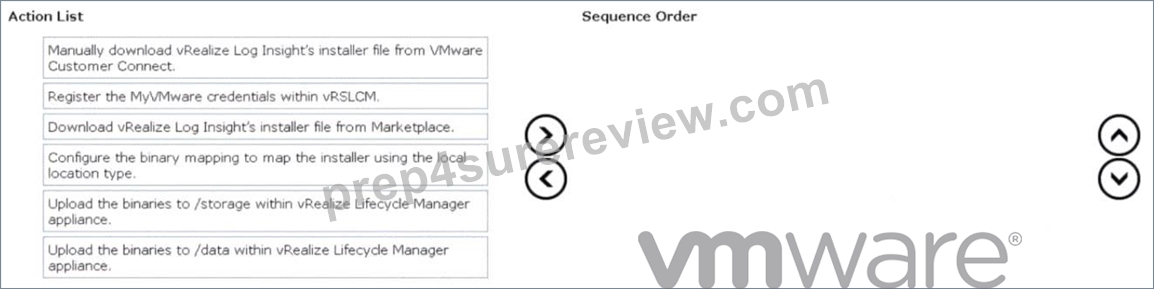
Answer:
Explanation: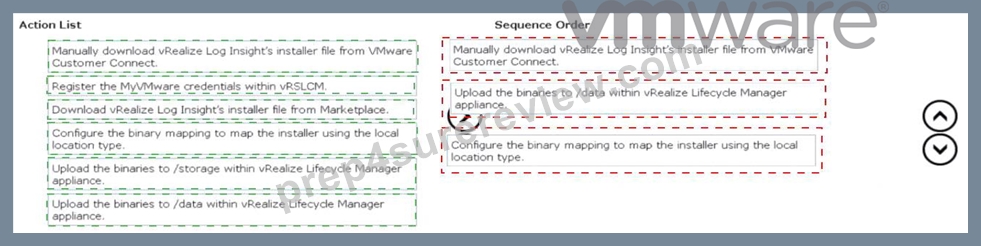
Explanation: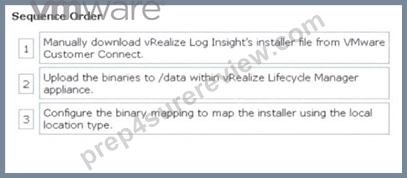
Manually download vRealize Log Insight's installer file from VMware Customer Connect:
* In an environment without internet connectivity, the installer file must be manually downloaded from VMware Customer Connect to your local system.
Upload the binaries to /data within vRealize Lifecycle Manager appliance:
* After obtaining the installer file, upload the binaries to the /data directory in the vRSLCM appliance.
This ensures the installer is locally available.
Configure the binary mapping to map the installer using the local location type:
* Map the uploaded installer binaries in vRSLCM using the local location type so that vRSLCM can reference the binaries during the installation process.
NEW QUESTION # 42
A cloud administrator needs to provide the security team with the ability to query and audit events and provide custom real-time alerts for the VMware NSX firewall running In VMware Cloud on AWS.
Which solution would the administrator use to accomplish this goal?
- A. VMware vRealize Network Insight Cloud
- B. CloudHealth by VMware
- C. VMware vRealize Operations Cloud
- D. VMware vRealize Log Insight Cloud
Answer: D
Explanation:
VMware vRealize Log Insight Cloud is a cloud-based log management and analytics solution that provides real-time visibility and analytics for VMware Cloud on AWS [1]. It allows security teams to query and audit events and set up custom real-time alerts. Additionally, it provides detailed insights into the activity of the VMware NSX firewall, allowing administrators to quickly identify suspicious activity and take action.
NEW QUESTION # 43
Which three components can be part of a virtual machine template? (Choose three.)
- A. Installed applications, tools, and patches
- B. vSphere tags
- C. Guest operating system
- D. Custom attributes
- E. Virtual Machine hardware configuration
- F. Virtual machine snapshots
Answer: A,C,E
Explanation:
To create a virtual machine template, you will need to configure the virtual machine hardware configuration, install the necessary applications, tools, and patches, and select the guest operating system. The template can also include vSphere tags and custom attributes to further customize the virtual machine. Additionally, the template can include virtual machine snapshots which will save the current state of the virtual machine and can be used to quickly restore the machine to the same state.
https://www.vmware.com/pdf/techsupportguide.pdf
VMware Technical Support Guide
https://www.vmware.com/pdf/techsupportguide.pdf
https://vcdx.vmware.com/content/dam/digitalmarketing/vmware/ru/pdf/techpaper/vmware- horizon-7-application-publishing.pdf Publishing Applications with VMware Horizon 7
https://vcdx.vmware.com/content/dam/digitalmarketing/vmware/ru/pdf/techpaper/vmware- horizon-7-application-publishing.pdf
https://www.vmware.com/topics/glossary/content/server-virtualization.html What is Server Virtualization? | VMware Glossary
https://www.vmware.com/topics/glossary/content/server-virtualization.html
NEW QUESTION # 44
An administrator is attempting to replace the SSL certificate for a vRealize Log Insight (vRLI) deployment.
The administrator can only see the Content Management service in the vRealize Suite Lifecycle Manager (vRSLCM) dashboard.
Which two roles could the administrator be assigned that will enable them to complete the certificate replacement using vRSLCM? (Choose two.)
- A. Assign the LCM Cloud Admin role in vRSLCM
- B. Assign the Certificate Admin role in vRLI
- C. Assign the Content Release Manager role in vRSLCM
- D. Assign the Certificate Administrator role in vRSLCM
- E. Assign the Super Admin role in vRLI
Answer: A,D
Explanation:
To replace the SSL certificate for a vRealize Log Insight (vRLI) deployment using vRealize Suite Lifecycle Manager (vRSLCM), the administrator must have the appropriate roles assigned within vRSLCM. The two roles that enable certificate management tasks are:
* LCM Cloud Admin:
* Description: This role grants administrative privileges within vRSLCM, including the ability to manage and replace SSL certificates for integrated products like vRLI.
* Responsibilities:
* Overseeing lifecycle operations for cloud management products.
* Managing configurations and performing administrative tasks within vRSLCM.
* Certificate Administrator:
* Description: This role specifically focuses on certificate management within vRSLCM, allowing the user to import, export, and replace SSL certificates for managed products.
* Responsibilities:
* Handling certificate-related operations, including replacements and renewals.
* Ensuring that all managed products have up-to-date and valid SSL certificates.
Without these roles, the administrator may lack the necessary permissions to access the certificate management features in vRSLCM, thereby hindering the SSL certificate replacement process for vRLI.
References:
* For detailed information on role assignments and permissions in vRSLCM, refer to VMware's official documentation:
* Change Certificate for vRealize Suite Lifecycle Manager
NEW QUESTION # 45
Which three types of gateways can be found in VMware cloud on AWS (Choose three?)
- A. Compute Tier-1
- B. Management Tire-0
- C. Tire-0
- D. Standard Tier-1
- E. Management Tire-1
- F. Distributed Tier-1
Answer: A,D,F
Explanation:
The three types of gateways that can be found in VMware Cloud on AWS are Option A: Distributed Tier-1, Option B: Standard Tier-1, and Option D: Compute Tier-1.
Distributed Tier-1 gateways are used for secure access between on-premises networks and the VMware Cloud on AWS SDDC network. Standard Tier-1 gateways are used for secure access between the VMware Cloud on AWS SDDC network and the public internet. Compute Tier-1 gateways are used for secure access between the workloads running on the VMware Cloud on AWS SDDC and the public internet.
For more information, please refer to the official VMware documentation on VMware Cloud on AWS Gateways: https://docs.vmware.com/en/VMware-Cloud-on-AWS/services/com.vmware.vmc- aws.networking/GUID-1F2D1BFC-F5C7-4534-8B49-39F9D08E7F1A.html
NEW QUESTION # 46
What is the purpose of the VMware Cloud on AWS Compute Gateway (CGW)?
- A. A Tier-0 router that handles workload traffic that is connected to routed compute network segments
- B. A Tier-1 router that handles workload traffic that is connected to routed compute network segments
- C. A Tier-1 router that handles routing and firewalling for the VMware vCenter Server and other management appliances running in the software-defined data center (SDDC)
- D. A Tier-0 router that handles routing and firewalling for the VMware vCenter Server and other management appliances running in the software-defined data center (SDDC)
Answer: B
Explanation:
Compute Gateway (CGW) The CGW is a Tier 1 router that handles network traffic for workload VMs connected to routed compute network segments. Compute gateway firewall rules, along with NAT rules, run on the Tier 0 router. In the default configuration, these rules block all traffic to and from compute network segments (see Configure Compute Gateway Networking and Security).
https://docs.vmware.com/en/VMware-Cloud-on-AWS/services/vmc-on-aws-networking-security.pdf
NEW QUESTION # 47
An administrator is configuring the log masking feature within vRealize Log Insight. Select the correct statement.
- A. A log mask configuration is applied only to the logs that are ingested after creating and enabling the configuration.
- B. A log mask configuration is applied to the all stored logs that after creating and enabling the configuration.
- C. A log mask configuration does not take precedence to a configured and enabled archival rule.
- D. A log mask configuration can be applied to logs in which the FieldName field and the filter criteria have Dynamic fields.
Answer: B
Explanation:
Questions no: 36 Verified Answer = A, B, C, and E Comprehensive Detailed Explanation with all VMware References = To create an identically configured deployment of a production vRealize Operations cluster managed by vRealize Suite Lifecycle Manager (vRSLCM), follow these steps:
* E. Export the configuration for the Production vRSLCM Environment [29]: Export the existing configuration of the production environment as a JSON file. This file contains all the necessary details for replicating the deployment.
* A. Create a new vRSLCM Environment using the JSON Configuration file [30]: Use the exported JSON file to create a new environment in vRSLCM. This will replicate the basic structure and settings of the production environment.
* B. Update the JSON file to replace any configuration details [31]: Modify the JSON file to update any specific configuration details, such as IP addresses, hostnames, and resource allocations, to match the requirements of the new deployment.
* C. Create new locker SSL certificates and passwords for the new deployment [32]: Generate new SSL certificates and passwords for the new deployment to ensure security and avoid conflicts with the production environment.
Questions no: 37 Verified Answer = D Comprehensive Detailed Explanation with all VMware References = When configuring the log masking feature in vRealize Log Insight, it's important to understand how it affects log data. The correct statement is:
* D. A log mask configuration is applied to all stored logs after creating and enabling the configuration [33]: Log masking in vRealize Log Insight is not limited to newly ingested logs. Once a log mask configuration is created and enabled, it applies retroactively to all stored logs that match the masking criteria. This ensures consistent masking across all relevant log data.
Here's why the other options are incorrect:
* A. A log mask configuration does not take precedence to a configured and enabled archival rule:
Log masking takes precedence over archival rules. If a log entry matches a masking rule, the masking will be applied before the archival rule is evaluated.
* B. A log mask configuration can be applied to logs in which the FieldName field and the filter criteria have Dynamic fields: Log mask configurations cannot be applied to logs with dynamic fields in the FieldName or filter criteria.
* C. A log mask configuration is applied only to the logs that are ingested after creating and enabling the configuration: As mentioned earlier, log masking applies to all stored logs, not just newly ingested ones.
NEW QUESTION # 48
When preparing to deploy VMware Cloud on Dell EMC or VMware Cloud on AWS Outposts In a data center, which two physical constraints must be considered? (Choose two.)
- A. Floor and elevator weight capacity between loading dock and datacenter
- B. Size of the doorways between loading dock and datacenter
- C. Having enough existing rack space for the components
- D. Having enough people to carry the equipment
- E. Distance between loading dock and datacenter
Answer: A,C
Explanation:
https://aws.amazon.com/vmware/outposts/faqs/
When deploying VMware Cloud on Dell EMC or VMware Cloud on AWS Outposts in a data center, it is important to consider the amount of existing rack space available for the components, as well as the floor and elevator weight capacity between the loading dock and the data center. The distance between the loading dock and the data center, the size of the doorways between the loading dock and the data center, and the number of people available to carry the equipment are not relevant factors to consider.
NEW QUESTION # 49
Which two features of the VMware cloud on AWS platform are part of service management process?
(Choose two.)
- A. Incident management
- B. Microsoft licensing management
- C. VMware Tools management
- D. Capacity management
- E. Workload OS management
Answer: A,D
Explanation:
Incident Management is responsible for handling customer incidents and ensuring customer satisfaction.
Capacity Management is responsible for ensuring that the service is sized appropriately for customer needs and that the capacity is monitored to ensure that it meets customer requirements. VMware Tools management, Microsoft licensing management, and workload OS management are not part of the service management process. https://www.vmware.com/topics/glossary/content/hypervisor.html What is a Hypervisor? | VMware Glossary
https://www.vmware.com/topics/glossary/content/hypervisor.html https://docs.vmware.com/en/VMware- Cloud-on-AWS/services/vmc-aws-operations.pdf VMware Cloud on AWS Operations Guide
https://docs.vmware.com/en/VMware-Cloud-on-AWS/services/vmc-aws-operations.pdf
https://www.vmware.com/topics/glossary/content/bare-metal-hypervisor.html What is a Bare Metal Hypervisor? | VMware Glossary https://www.vmware.com/topics/glossary/content/bare-metal- hypervisor.html
NEW QUESTION # 50
In order to provide overlapping IP address segments within a VMware cloud Environment, what must be configured?
- A. Additional network segments
- B. Additional Tier-1 gateways
- C. Additional Tier-O gateways
- D. Additional NSX Edge appliances
Answer: B
Explanation:
https://vmc.techzone.vmware.com/understanding-segments-vmc-aws
NEW QUESTION # 51
Which two steps should an administrator take to allow HTTPS access to a specific virtual machine (VM) through the public Internet for VMware Cloud on AWS? (Choose two.)
- A. Request a public IP address in the VMware Cloud console.
- B. Configure a DNAT rule translating a public IP address to an internal IP address.
- C. Configure AWS Direct Connect.
- D. Create a custom service called HTTPS using port 443.
- E. Configure a SNAT rule translating an internal IP address to a public IP address.
Answer: A,D
Explanation:
To allow HTTPS access to a specific VM through the public Internet for VMware Cloud on AWS, the administrator must first create a custom service called HTTPS using port 443. They must then request a public IP address in the VMware Cloud console.
NEW QUESTION # 52
An administrator is setting up vSphere integration for syslog collection from ESXi hosts in vRealize Log Insight. Which one is the correct permission required in vSphere?
- A. Host.Configuration.Change Settings
- B. Security profile and firewall Configuration
- C. Host.Network Configuration.Configuration
- D. Configuration.AdvancedSettmgs.Host
Answer: D
Explanation:
To set up vSphere integration for syslog collection from ESXi hosts in vRealize Log Insight, the required permission in vSphere is Configuration.AdvancedSettings.Host.
Explanation:
* Configuration.AdvancedSettings.Host:
* This permission allows modification of advanced host settings, including configuring syslog parameters necessary for directing ESXi logs to vRealize Log Insight.
Steps to Assign Permission:
* Access vSphere Client:
* Log in to the vSphere Client with administrative privileges.
* Navigate to Host Permissions:
* Select the ESXi host or cluster where you want to assign the permission.
* Go to the Permissions tab.
* Assign Role with Required Permission:
* Create a new role or modify an existing one to include the Configuration.AdvancedSettings.
Host privilege.
* Assign this role to the user or group responsible for configuring the syslog settings.
NEW QUESTION # 53
......
Updated Verified 2V0-32.22 dumps Q&As - Pass Guarantee or Full Refund: https://www.prep4surereview.com/2V0-32.22-latest-braindumps.html
2V0-32.22 PDF Questions and Testing Engine With 100 Questions: https://drive.google.com/open?id=14jTS7KxUvuThDaPqOqc49I23sstwcYAU
