
[UPDATED 2026] Getting NCP-CI-Azure Certification Made Easy!
NCP-CI-Azure Exam Crack Test Engine Dumps Training With 83 Questions
NEW QUESTION # 33
What is the minimum number of nodes needed to deploy an RF3 NC2 cluster?
- A. 0
- B. 1
- C. 2
- D. 3
Answer: B
Explanation:
Replication Factor (RF3): RF3 requires that data is replicated across three different nodes to ensure data durability and fault tolerance. This replication scheme allows the system to tolerate the failure of two nodes simultaneously.
Minimum Node Requirement for RF3: To meet the RF3 requirements while maintaining operational capability, a minimum of five nodes is necessary. This configuration ensures that there are enough nodes to distribute the data and provide the necessary redundancy.
Reference:
Nutanix Replication Factor Documentation
Nutanix NC2 on Azure Deployment Guide
NEW QUESTION # 34
A company wants NC2 networking components to be created manually with the correct naming conversation. To achieve this the administrator manually creates the PC and Host VNets in Azure.
What additional Azure Network components must the administrator manually create?
- A. NAT Gateways, Delegated Subnets, Flow Gateway Subnets, VNet Peers
- B. Internet Gateways. Delegated Subnets, Flow Gateway Subnets, VNet Peers
- C. internet Gateways, Private Endpoints, Flow Gateway Subnets, VNet Peers
- D. NAT Gateways. Delegated Subnets, Flow Gateway Subnets, Transit VPC
Answer: A
Explanation:
NAT Gateways: Necessary for providing outbound internet access to resources in the private subnet. It ensures that the virtual network can communicate with external services securely.
Delegated Subnets: Required for deploying specific Azure services within the virtual network, allowing controlled access and management of the resources within these subnets.
Flow Gateway Subnets: These subnets are used for managing traffic flow within the network, ensuring efficient routing and connectivity between different parts of the NC2 infrastructure.
VNet Peers: Establish connections between different virtual networks within Azure, enabling seamless communication and resource sharing across various parts of the NC2 deployment.
Reference:
Azure Virtual Network Documentation
Nutanix NC2 Networking Setup Guide
NEW QUESTION # 35
An administrator ran into an issue during an NC2 cluster deployment on Azure. The administrator has logged a case with Nutanix Support.
Support has requested the following logs from NC2 on Azure in order to diagnose the deployment issue:
* Cluster_agent
* Host_agent
* Hostsetup
What action should the administrator take to ensure the collect the appropriate logs?
- A. Login to Prism Element to access the CVM's console and run the logbay collect command.
- B. SSH to the CVM and use the logbay collect command.
- C. Login to Prism Element Web Console to generate a Logbay bundle.
- D. SSH to the PCVM and use the logbay collect command.
Answer: A
Explanation:
To collect the appropriate logs (Cluster_agent, Host_agent, and Hostsetup) for diagnosing the deployment issue with Nutanix Support, the administrator should:
* Log in to Prism Element to access the Controller VM (CVM) console.
* Run thelogbay collectcommand from the CVM console. This command collects the necessary logs and packages them for support.
This method ensures that the correct logs are gathered in a format that Nutanix Support can analyze.
References
* Nutanix Support Documentation on Log Collection
NEW QUESTION # 36
An administrator has been tasked with scoping an NC2 on Azure deployment. One of the requirements is to ensure that the bare metal instance will support up to 20 TB of storage capacity.
Which bare metal instance should the administrator choose?
- A. HB176rs
- B. ND96asr
- C. AN36
- D. AN36P
Answer: D
Explanation:
Storage Capacity Requirement: The requirement specifies that the bare metal instance must support up to 20 TB of storage capacity.
Instance Selection: Among the provided options, the AN36P instance is designed to support higher storage capacities and performance needs.
AN36P Capabilities: The AN36P instance is optimized for storage-intensive applications and provides the necessary hardware specifications to handle up to 20 TB of storage.
Comparison with Other Instances:
ND96asr: Typically optimized for GPU workloads rather than storage.
AN36: May not meet the 20 TB storage requirement.
HB176rs: Geared towards high-performance computing rather than large storage capacities.
Conclusion: Based on the requirements and instance specifications, AN36P is the most suitable choice for supporting up to 20 TB of storage.
Reference:
Nutanix NC2 Instance Types
Azure Virtual Machine Sizes
NEW QUESTION # 37
An administrator deploys an NC2 cluster in Azure and uses 10.100.0.0/16 for one of the VNets.
The cluster is configured as follows:
* 8 nodes
* Prism Central Deployed
* Files Deployed
Following the deployment, the administrator experiences network connectivity issues.
Which reason explains the connectivity issues?
- A. 10.100.0.0/16 range is reserved for internal cluster usage.
- B. The 10.100.0.0/16 range is not a valid CIDR range.
- C. The 10.100.0.0/16 range is reserved by IANA.
- D. The W.100.0.0/16 range contains too many IP addresses for an NC2 cluster.
Answer: A
Explanation:
Network Configuration: Using a specific IP range for a VNet can cause conflicts if that range is reserved or already in use by the cluster's internal operations.
Internal Usage: In NC2, certain IP ranges are reserved for internal cluster functions and should not be used for VNets to avoid IP conflicts and connectivity issues.
Impact: If the 10.100.0.0/16 range is reserved for internal usage, using it for a VNet would lead to IP conflicts, causing network connectivity issues.
Verification: It's important to verify the reserved IP ranges in the NC2 documentation before assigning them to VNets.
Conclusion: The connectivity issues are likely due to using the 10.100.0.0/16 range, which is reserved for internal cluster usage.
Reference:
Nutanix Networking Guidelines
Azure Virtual Network Documentation
NEW QUESTION # 38
An administrator is tasked with creating a new subnet for a group of VMs that require inbound internet access.
Internal private addresses must be obscured to servers on the public internet.
Which network is best suited for satisfying this requirement?
- A. No-NAT based network
- B. Layer 2 Stretch network
- C. NAT based network
- D. Bastion based network
Answer: C
Explanation:
* NAT Based Network:A NAT-based network is designed to provide inbound and outbound internet access while obscuring the internal private addresses. This setup uses Network Address Translation (NAT) to map internal IP addresses to a public IP address, ensuring that internal addresses are not exposed to the public internet.
* Security and Connectivity:NAT provides a layer of security by hiding internal IP addresses and allowing controlled access to external resources. This configuration is well-suited for VMs that need to communicate with servers on the public internet while maintaining the privacy of their internal network addresses.
References:
* Azure Virtual Network NAT Documentation
* Nutanix Networking and Security Configuration Guide
NEW QUESTION # 39
When configuring an alert email in Prism Central deployment within an NC2 environment, what is required in order for the emails to be sent properly?
- A. Cluster Super Admin permissions
- B. A whitelisted public cloud console endpoint
- C. Name servers configure in Prism Central
- D. SMTP server configured in Prism Central Settings
Answer: D
Explanation:
* SMTP Server Configuration:To send alert emails from Prism Central, it is essential to configure an SMTP server in the Prism Central settings. This server handles the email sending process, ensuring that alerts generated by Prism Central are properly delivered to the specified email addresses.
* Email Notification Setup:The SMTP server settings include the server address, port, and authentication details. Once these settings are correctly configured, Prism Central can use the SMTP server to send out alert emails reliably.
References:
* Nutanix Prism Central Administration Guide
* SMTP Configuration for Email Alerts in Prism Central
NEW QUESTION # 40
Exhibit.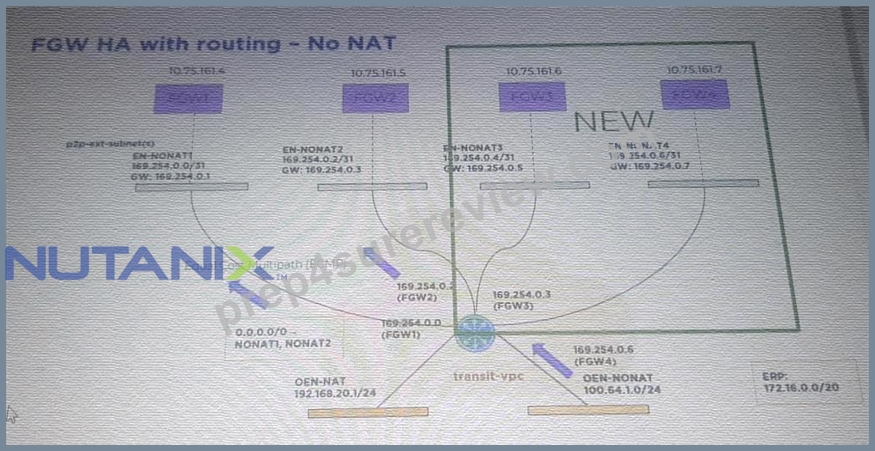
AN NC2 on Azure Cluster was deployed with two Flow gateways in HA (FGW1 and FGW2). After a week of use. Four bare-metal nodes, were added to the NC2 cluster and additional workloads were added.
It was determined that additional bandwidth for north/South traffic would be needed. Two additional Flow gateways were added (FGW3 and FGW4) from the NC2 portal configuration menu.
The existing workloads prior to expansion on the NC2 cluster will be able to use which Flow Gateways using the No-Nat (routed) traffic path?
- A. All Flow Gateways can be used.
- B. Only the Flow Gateway that each workload was originally using.
- C. FGW1&FGW2 only, new workloads can use FGW3 & FGW4.
- D. All Flow Gateways can be used after the existing workloads reboot.
Answer: A
Explanation:
In the scenario presented, the NC2 cluster was initially deployed with two Flow Gateways (FGW1 and FGW2) in HA. After adding four bare-metal nodes and additional workloads, two more Flow Gateways (FGW3 and FGW4) were added to handle the increased bandwidth for north/south traffic. Given the configuration, the existing workloads can utilize all available Flow Gateways (FGW1, FGW2, FGW3, and FGW4) for No-NAT (routed) traffic paths. This setup allows for Equal Cost Multipath (ECMP) routing, distributing traffic load across all Flow Gateways.
References
* Nutanix Flow Networking
NEW QUESTION # 41
A new subnet needs to be created within Flow Virtual Networking to accommodate a new type of workload in the company's NC2 Azure instance.
Which type of network will satisfy this task?
- A. VPC
- B. Underlay
- C. VNET
- D. Overlay
Answer: D
Explanation:
* Flow Virtual Networking: Nutanix Flow Virtual Networking allows for the creation of overlay networks to segment and manage network traffic.
* Network Types:
* Underlay: Refers to the physical network infrastructure.
* Overlay: Logical network built on top of the physical infrastructure, providing flexibility for creating isolated subnets and accommodating different workloads.
* VPC: Virtual Private Cloud, a network within a public cloud provider.
* VNET: Azure-specific virtual network.
* Requirement: Creating a subnet for new workloads within Flow Virtual Networking suggests using an overlay network for logical separation and management.
* Conclusion: An overlay network within Flow Virtual Networking will satisfy the task of accommodating a new type of workload in the NC2 Azure instance.
References:
* Nutanix Flow Networking Guide
* Azure Virtual Network Documentation
NEW QUESTION # 42
What action is performed in Azure when an instance is reported as being in a terminated state, but NC2 expects it to be in a running state?
- A. NC2 restarts the AHV host.
- B. NC2 condemns the host and triggers replacement of the host.
- C. NC2 automatically reconnects with the instance.
- D. NC2 alerts the administrator that a manual replacement is required.
Answer: B
Explanation:
* Instance Termination Detection:When an instance in Azure is reported as being in a terminated state but NC2 expects it to be running, the system will automatically take corrective actions.
* Host Condemnation and Replacement:NC2 will condemn the host, marking it as unusable, and will then trigger the replacement process to ensure that the cluster maintains its required capacity and performance levels. This automatic handling ensures minimal disruption to the workloads running on the cluster.
References:
* Nutanix NC2 Automated Management Features
* Azure Instance State Documentation
NEW QUESTION # 43
An administrator wants to ensure that enough available bandwidth exits for workloads running in an NC2 on Azure cluster environment.
What is the highest number of Flew Gateway VMs that can be deployed within this environment?
- A. 0
- B. 1
- C. 2
- D. 3
Answer: C
Explanation:
Flow Gateway VMs: Flow Gateway VMs are used to manage and route network traffic within an NC2 on Azure cluster, ensuring sufficient bandwidth for workloads.
Scalability: To ensure enough available bandwidth, multiple Flow Gateway VMs can be deployed.
Maximum Limit: The highest number of Flow Gateway VMs that can be deployed within an NC2 on Azure environment is 6, providing the necessary capacity to handle high traffic volumes and ensure optimal performance.
Conclusion: Deploying up to 6 Flow Gateway VMs ensures adequate bandwidth for NC2 workloads.
Reference:
Nutanix Clusters Networking Guide
Azure Network Performance Documentation
NEW QUESTION # 44
An administrator has been tasked with scoping an NC2 on Azure deployment. One of the requirements is to ensure that the bare metal instance will support up to 20 TB of storage capacity.
Which bare metal instance should the administrator choose?
- A. HB176rs
- B. ND96asr
- C. AN36
- D. AN36P
Answer: D
Explanation:
* Storage Capacity Requirement: The requirement specifies that the bare metal instance must support up to 20 TB of storage capacity.
* Instance Selection: Among the provided options, the AN36P instance is designed to support higher storage capacities and performance needs.
* AN36P Capabilities: The AN36P instance is optimized for storage-intensive applications and provides the necessary hardware specifications to handle up to 20 TB of storage.
* Comparison with Other Instances:
* ND96asr: Typically optimized for GPU workloads rather than storage.
* AN36: May not meet the 20 TB storage requirement.
* HB176rs: Geared towards high-performance computing rather than large storage capacities.
* Conclusion: Based on the requirements and instance specifications, AN36P is the most suitable choice for supporting up to 20 TB of storage.
References:
* Nutanix NC2 Instance Types
* Azure Virtual Machine Sizes
NEW QUESTION # 45
An administrator is tasked to identify the firewall requirement and submit the port request to the requirement team before the clusters deployment.
Which requirement should the administrator ensure is implement on the corporate firewall?
- A. Allow uni-directional internet Control Message Protocol (ICMP) traffic between the CVMs, femenr and Prism Central.
- B. Allow bi-directional Internet Control Message Protocol (ICMP) traffic between the CVMs, Prism Element, and Prism Central.
- C. ICMP can disable but the connectivity should be enabled between the CVMs. Prism Element, and Prism Central.
- D. ICMP and connectivity can be disabled between the CVMs, Prism Element, and Prism Central
Answer: B
Explanation:
ICMP Traffic: ICMP is essential for network diagnostics and troubleshooting, such as ping and traceroute, which help in monitoring the connectivity and health of the network.
Bi-Directional Traffic: Allowing bi-directional ICMP traffic ensures that all nodes (CVMs, Prism Element, and Prism Central) can both send and receive diagnostic messages, which is crucial for maintaining proper communication and network stability.
Reference:
Nutanix Networking and Connectivity Requirements
Corporate Firewall Configuration Guidelines
NEW QUESTION # 46
An administrator deploys a new NC2 cluster in Azure in a new subscription. No VPN or Express Route exists.
Which two actions will allow the administrator access to Prism Central to start the configuration? (Choose two.)
- A. Deploy a Jump Host VM instance in the Prism Central VNet inside a non-delegated subnet.
- B. Deploy a Jump Host VM instance in the Prism Central VNet inside a delegated subnet.
- C. Deploy a Jump Host VM instance and NAT Gateway in an external VNet and peer the VNets.
- D. Deploy a Jump Host VM instance in an external VNet and peer the VNets.
Answer: B,D
Explanation:
* Jump Host VM in External VNet with VNet Peering:
* Deploy Jump Host VM:Deploy a VM in an external VNet that is not within the same network as Prism Central.
* VNet Peering:Establish VNet peering between the external VNet and the Prism Central VNet.
This allows the Jump Host to communicate with Prism Central securely.
* Jump Host VM in Prism Central VNet Inside a Delegated Subnet:
* Deploy Jump Host VM:Deploy the Jump Host VM directly in the Prism Central VNet within a delegated subnet. This places the Jump Host in the same network environment as Prism Central, allowing direct access.
References:
* Azure VNet Peering Documentation
* Nutanix NC2 Networking and Access Configuration Guide
NEW QUESTION # 47
The cluster has the following configuration:
A Transit VPC exists as Default, but is additionally configured with a overlay-external-subnet-nonat overlay subnet The ERP for the Transit VPC is 10.1.1.0/25 A User VPC exists named User_VPC_Prod The ERP for the User VPC is 10.1.1.0/24 Outbound and inbound routes have been configured A User VM NO-NAT subnet has been configured in the User VPC The administrator has successfully created a VM and added the NIC associated with the NO-NAT subnet, but is not able to communication with other resources.
Which option will resolve this issue?
- A. Verify that the route table associated with the User VPC has appropriate routes to the Transit VPC.
- B. Ensure that the security groups associated with the VM allow traffic to and from the desired resources.
- C. The ERP in the User VPC must be from a different CIDR range than the ERP in the transit VPC.
- D. Check that the network ACLs for the NO-NAT subnet are not blocking the necessary traffic.
Answer: C
Explanation:
In this scenario, the issue arises from overlapping IP address ranges between the Transit VPC and the User VPC. Here's a detailed breakdown:
* Understanding ERPs (Elastic Routing Prefixes):
* The ERP for the Transit VPC is 10.1.1.0/25, which covers IP addresses from 10.1.1.0 to
10.1.1.127.
* The ERP for the User VPC is 10.1.1.0/24, which covers IP addresses from 10.1.1.0 to 10.1.1.255.
* IP Address Overlap:
* Since 10.1.1.0/25 is a subset of 10.1.1.0/24, there is a significant overlap in the IP address ranges of these two ERPs.
* This overlap can cause routing issues because the same IP address range is being used in both VPCs, leading to ambiguity in routing and communication.
* Communication Issue:
* When a VM in the User VPC tries to communicate with other resources, the network cannot accurately determine the correct route due to the overlapping IP address ranges.
* This overlap prevents proper routing and results in the VM being unable to communicate with other resources as intended.
* Resolution:
* To resolve this issue, the ERPs must be in different CIDR ranges. This means the IP address ranges for the Transit VPC and the User VPC should not overlap.
* For example, if the Transit VPC uses 10.1.1.0/25, the User VPC could use a different range such as 10.1.2.0/24 or any other range that does not overlap with 10.1.1.0/25.
By ensuring that the ERPs are in different CIDR ranges, the network can properly route traffic between the VPCs without any conflicts or ambiguities, thereby enabling the VM in the User VPC to communicate with other resources effectively.
NEW QUESTION # 48
......
NCP-CI-Azure Exam Dumps Contains FREE Real Quesions from the Actual Exam: https://www.prep4surereview.com/NCP-CI-Azure-latest-braindumps.html
Obtain the NCP-CI-Azure PDF Dumps Get 100% Outcomes Exam Questions For You To Pass: https://drive.google.com/open?id=13MNg5_we8kDdRwNeiIoVJMQi70PVgjin
